
Making a New Mallet: Thagomizer Jr.

My trusty mallet, Thagomizer, has really been taking a beating in the last year. I think I’ve had to glue it back up about four or five times now. With some extra time on my hands, it was time to build a replacement.

I liked a lot of things about the mallet, but did some silly things when I made it. The handle turns out to be a little too short, and for whatever reason, I put a finish on it. I guess I was on a varnishing kick back then; come to think of it, I really didn’t have anything else to varnish at the time. (I used rottenstone on this? Really?)

However, what interests me most is the question of if I could make a new one last longer. Everything on the original was very durable, except for the top of the head. It picked up a habit of splitting late in life. My first step was to take a good look at what had happened:
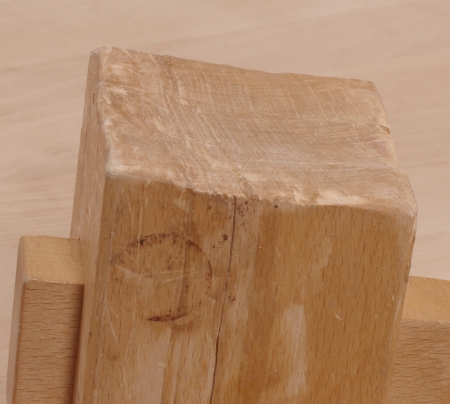
Notice that the face has become concave after repeated pounding. The fractures are all mostly in the top 1/3 of the head. I suspect that what’s going on here is that smacking something (like a holdfast) on the upper part of that concavity put a lot of shear force along the top, and that’s why it did what it did. Back in this post (way back when no one ever read this blog), I explained that I wasn’t going to put a bevel on the top because I was being lazy. So perhaps those bevels aren’t there just for show, and I knew one thing that I needed to do in the new one.

Because I didn’t have any really thick stock at the time, I built the old mallet by face-gluing pieces of wood. That turned out to be pretty durable, so I did the same thing this time, using the same trick to get the hole in the middle, except that I was considerably less meticulous about it:

I used a bunch of scrap wood this time (but from the same board as the old Thagomizer!), and decided that I cared only to (sorta) align the pieces on the bottom of the head because I’d just be chopping off massive pieces anyway. This might look a little stupid, but not nearly as stupid as what I did for the new handle:

I had the perfect piece of scrap, but it was just a tad too narrow, so I glued another piece of scrap to the end to get what I needed (and sawed most of it away in the end).

So I had the head and handle parts glued up, and it was time to shape everything. Here again, I was considerably less meticulous than last time. I sawed most of everything on the head, did the final passes on the top of the head with my jack plane with the deep camber, and chamfered the sides with that plane as well. As far as the handle goes, on the last one, I’d been all enthusiastic about using a spokeshave. Well, that spokeshave enthusiasm doesn’t happen nearly as often to a man who has a Shinto saw rasp in his hand. (Save the spokeshave for more delicate tasks.)

When everything was said and done (in a far less amount of time than the original), I had Thagomizer Jr.:
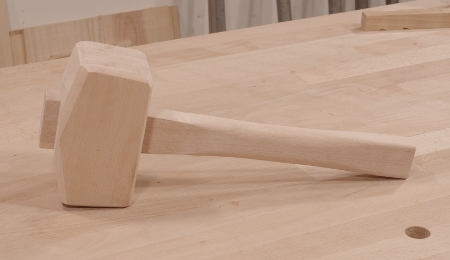
The top of the head is beveled down, the corners at the top are considerably chamfered, and the handle is a couple of inches longer. The head weighs a little less than the original, but the extra handle length probably brings it to about the same weight, but with a different balance.

So I’m ready to start beating on stuff now. Here’s a comparison of the original and new one:
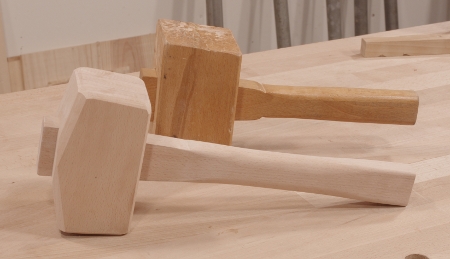
Time and use will tell if the alterations do what they’re supposed to do.


7 thoughts on “Making a New Mallet: Thagomizer Jr.

  1. Brian,

    The new mallet looks pretty nice. I usually apply whatever finish to my shop accessories if there’s a bit left over in the gun or on the brush, but I’ve never rubbed it out!

    Chris

  2. Nice, I have tried a few times to make a mallet. What wood do you use? I have tried hickory and ash and both have performed miserably. The hickory keeps splintering off parts of the head. The ash may have performed better and maybe I did a bad job laminating that. It was one of my first projects so it was hard to remember. I think it cracked more than splintered. I also made one out of red oak pallet wood that has held up, but I don’t use it much because it’s small, uncomfortable and looks like so primitive that even Fred Flintstone would laugh at it.

    • Hi Bryan, I used beech for this. European mallets and other tools are made from this wood, mostly because it’s cheap and available there. The price in the US really depends on where you get it; American beech can be pretty cheap.

      I’d imagine that red oak is an okay choice, given that people use oaks for tool handles. Hickory would be great for the handle, but it does split very easily, so it’s not so great for the head. Other woods that would probably be okay are elm, maple, birch, maybe even cherry (though cherry is prone to checks and splitting). My view is that the wood should be hard, but not too hard. If you use something like hard maple or yellow birch, you run the risk of destroying your chisel handles if you hit them too hard. It’s much easier to replace a mallet than constantly replace handles.

      Of course, some people have the opposite view, preferring something really hard and heavy such as lignum vitae stuffed into a metal shell.

      One tip on lamination: When using your jointer plane to get the gluing faces flat, press down a little harder in the center of the cut so that you form a slight concavity, just as if you were edge-jointing. You can check this with a straightedge or by placing the face onto a flat surface and twisting it. If the face is just a little convex, it will easily spin around when you twist. If it’s concave (or perfectly flat), the edges will catch, and you’ll feel much more resistance.

      A final note: don’t worry so much about the appearance of a tool like this. An ugly tool that works is so much better than a pretty tool that doesn’t (unless you’re trying to sell it, I suppose).

      • Thanks Brian, I live in Raleigh, NC, and finding wood can be a bit challenging. Most of the lumber yards are just pine framing and pressure treated lumber. There are a few hardwood stores, but most focus on either exotics or the standard maple, oak, cherry, walnut. Things like beech, elm, sycamore, myrtle, and birch are hard to find from the big guys, but occasionally you can find a small mobile mill guy that will have a few boards of whatever he can get. I have a great source of 4/4″ quarter sawn oak, but that’s about it.

        • Hi Bryan, I know what you mean when it comes to finding wood. I was really lost when I started out here in California because essentially none of the American hardwoods grow here. You’re in a much better spot (close to St. Roy’s home base!) but it takes some time to seek out sources. One idea is to check out the materials section of craigslist from time to time, sometimes you find stuff.

          Another thing that helped me out a lot was to make a bunch of woodworking friends in the area.

          (I sorta wonder if dry southern yellow pine would work for a mallet head.)

  3. Pingback: The New Classic Mallet « Toolmaking Art

Leave a Reply

Your email address will not be published. Required fields are marked *

You may use these HTML tags and attributes: <a href="" title=""> <abbr title=""> <acronym title=""> <b> <blockquote cite=""> <cite> <code> <del datetime=""> <em> <i> <q cite=""> <strike> <strong>