
Nightstands v2: Exterior Frame A

The new twin-nightstand project is coming along. After some quality time with saws and planes, I had all of the external frame pieces milled for each piece:

In the center are eight sticks of yellow-poplar that I salvaged from an old bed frame. They’ll be used for the rear of the nightstands. Looking at the timestamps of the photos, it looks like it took (gasp) almost two weeks to produce this stack. That’s just the speed you’ll experience when you’re working by hand, have at most an hour and a half to work each day, and maybe aren’t the quickest person around. (Would a bandsaw greatly facilitate the speed? You bet it would.)

The next step was to come up with a frame map, as I did for the previous nightstand. Because there are so many components in this piece, it’s best to keep close track of them. And again, as I did in the previous version, I made a really ugly but still-workable and accurate drawing:
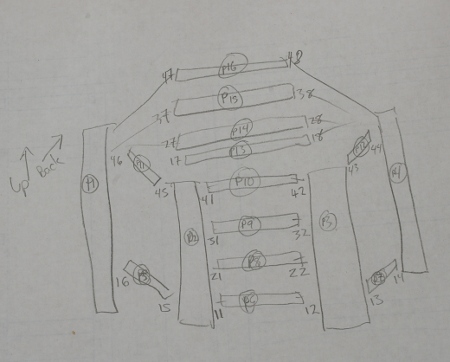
There are two kinds of labels here. One begins with a P, meaning “piece,” so P1 is the far left leg in this case. The others, which are simply numbers, label joints. The joints are in four vertical levels in the piece, so I decided to have the lower-level joints start with 1, the next with 2, and so on. Then, the second number denotes the position. In this drawing, the x1 joints are in off the right side of the front left leg. So joint 11 is the lowest one of these, and 21, 31, and 41 are directly above. Naturally, in this system, there will be plenty of holes–for example, there are no joints 25 or 35.

Finally, because there are to be two identical nightstands, I decided to add a letter A or B to the end to identify each one. So you’ll have all sorts of labels like P3A and 43B.

Whew. But that wasn’t the hard part. That honor went to planning which piece would go where:

If I recall correctly, the components for piece A are on the right and piece B’s are on the left. In any case, it was tricky. Because the components came from different offsets into a single flatsawn board, the cut profiles were different. The ones from the center were more or less quartersawn in flavor, but most were riftsawn in one way or the other. The worst part was that two of the legs had very tangential grain on their sides because they came from the center of the board. To produce a consistent look, I decided to put both of those legs on one side, and use matching rails between them. The reason? You can’t look at both sides at once, and in the end, I can always choose to hide that side against the side of the bed if it looks too ridiculous. In any case, that will be on nightstand A, and I’ll try to show that when all of this is done.

I wasn’t just trying to match the grain on each side, though. I decided to try out the arrangement of shoji described in Toshio Odate’s book, where you arrange the pieces so that the core of the tree is pointing inward (bark side out). Because this is a 3-D piece, I also tried to place the legs and rails so that the cores would face the interior of the nightstand. It didn’t look so bad to me, so maybe this traditional arrangement has a bit of merit.

With everything arranged, I labeled each piece and its orientation, put half of the pieces away, and started work on the actual joinery. One week later, and I’ve finished the 24 mortise-and-tenon joints of the exterior frame of nightstand A:

Hey, how about that, it doesn’t seem to look too bad and it took a lot less time than I thought it would. Now it’s B’s turn.

Or, it will be B’s turn when the Thagomizer recovers from its run-in with a holdfast. I broke it in a different spot this time, a clean shear across the top:
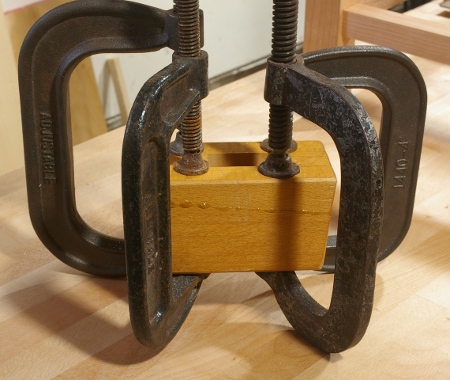
Of course, it had to wait until I was working on the next-to-last mortise. I finished that one and the final one with it still broken (it hadn’t split down the middle). Then I removed the head, gunked on and spread the hide glue, and clamped it together. Yeah, I’ve thought about making a new mallet one of these days, but I just don’t have the time right now to be dorking around with tools (sigh). Maybe when this project is near an end and in the finishing process.
Chisels: 1, Thagomizer: 0

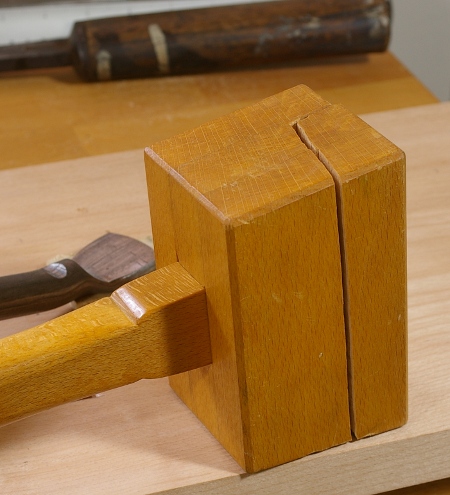
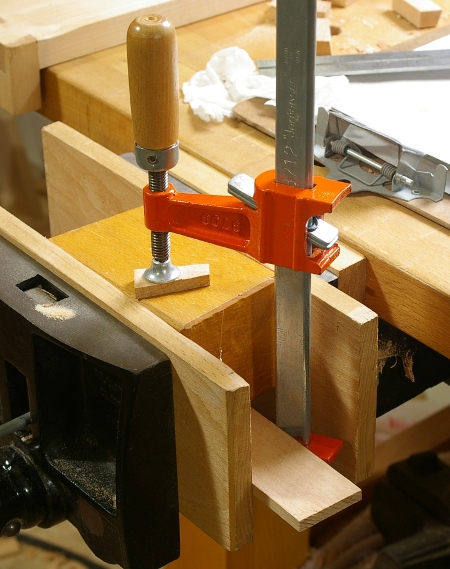
There I was, thumping away at a mortise in the stool top. Whap whap WHAP, hey, something just got funny. Remember how I hinted that the Ash chisel handle might bite it? Well, it turns out that the chisel made a pre-emptive strike (notice the perpetrator lurking in the background here):

A totally predictable failure pattern, I suppose. I did the only natural thing here and glued it back together:

I don’t know how long this repair is going to last.[*] In theory, it should be okay if I manage to strike in the center of the mallet, but then again, the ultimate reason that this happened was because I didn’t hit the chisel handle in the center.

There’s a lesson to be learned here. Maybe one or more of these will help in the future:

  • A bigger mallet for bigger jobs like this. [note: see Joel's comment below on why this may not be the greatest of ideas]
  • Strike in the center.
  • Make the mallet out of wood with an interlocked grain.
  • Not hit the chisel so hard.

[Edit: July 24, 2011, about a year and three months later. However, the new break was totally different.]

Mallet: finished

In a previous episode, I had just given the mallet an oil/varnish blend finish to give it its color. Then I left for two weeks of vacation, and a week ago, I came back, ready to hit it with some polyurethane.

I wanted to use polyurethane for two reasons: first, I’d never really done much with varnish before, and I thought it was about time to start. Second, it’s good stuff against dirt and sweat, and it’s tough. So off I went and thinned it way too much, so it took a week to get all of the coats on.

I used a “satin sheen” on it, because I’m not big on shiny stuff. Today, I was able to finally hit it with some rottenstone and get the final result:

It’s sitting on top of a piece of the same roughsawn european beech board that it was made from. I guess that’s progress.

Here’s a shot of the top. I managed to get the ray fleck there, so I left it as-is. I’m fairly pleased at the way the end grain turned out.

There are a few flaws. But this is, after all, a striking tool, and I don’t know how pretty it’s gonna look after a period of using it as intended. Incidentally, I am pleased at how it has performed in a few tests so far. The real test comes when I try to make a mortise and tenon (or pretty much anything) again, and I reach for this thing.

Vacation stuff

I’m back from two weeks of being in PA. For some strange reason, I paid a lot more attention to the trees this time. Gee, I wonder why. Penn State’s campus has some great native trees.

I fooled around with polyurethane on the mallet today. No pictures yet, but they wouldn’t be earthshattering, especially since it isn’t a gloss version. I used way too much thinner, so I’m not getting a very thick film on there. On the upside, I’m not getting any bubbles or brushstrokes or anything.

Something is happening, at least. I’ll probably need at least four coats with this thickness. That’s okay, I’m not in a hurry.

Mallet, touch-up

This morning, I took out the chamfering attachment to my low-angle block plane and set to work on the head. This was relatively easy work, and soon I had moved to the handle. I tried to work out some funny stuff that was going on in the handle, but wasn’t altogether successful. This is okay, because this (and one flaw on the head) does not affect the operational aspects of the tool.

When it was all said and done, I had this:

Groovy. I tested its grip and balance a little. It’s mostly to my liking; when I make the next one, I may put a thicker handle on it.

That left the finish. I went to the local hardware store and found nothing that I could stand. So I decided to use the same oil/varnish blend (“danish oil”) that I put on the workbench. This means that the mallet will show camouflage with the bench (because it’s made of the same wood), but this is okay.

I was a little disappointed at having to use the same finish as earlier because I really want to get started with varnishes. What I will probably do, however, is apply clear non-gloss polyurethane on top once the oil/varnish cures. This should provide a lot more protection against sweat and grime.

Mallet handle

I cut out the handle with a combination of a dovetail saw, a coping saw, a chisel, and a low-angle block plane. I would do a few things differently when marking next time, but it’s not like it’s a big deal.

The mallet components now looked like this:

Not bad. The handle fits the head, and it definitely feels like something you can whack stuff with. Except for those nasty sharp edges. I marked out the cross-section on the end of the handle and set about it with a spokeshave:

This was the first time I used a spokeshave! That was fun. Though I might want to try getting my Stanley #151 in working shape. It’s not easy to adjust the depth on the #51 I was using, but then again, it wasn’t that bad.

There was the very edge of a knot on one side of the handle, so that made it difficult to avoid tearout. So I used a little sandpaper to even out that part, and now we’re getting somewhere:

Still left to do is chamfer some edges, even up the head faces, and apply a finish. I have decided against an additional bevel on the top of the head, partly because I like the ray-fleck pattern, and partly because I feel lazy.

Mallet head, Part 2

After waiting a day for the glue to cure, I removed the clamps and set out to remove the center of mallet head. It was a piece of cake with that small tenon saw:

Then it was time to glue and clamp the third piece of the head:

Then there would be another day of waiting. Well, I did mark out the piece for the handle before calling it a day, but that’s not much work.

Mallet head, Part 1

I marked out three sections of the milled lumber in the shape of the mallet head and cut them out. Except that I didn’t do the top bevel; I figure that I can do it after I glued the thing up.

I picked out a piece for the center and marked out the part where the handle will go through. After paring to the knife edge, I sawed partway down the sides. Finally, I knocked out a little bit off the top area between the saw kerfs so that it ended up looking like this:

The reason for removing that piece was that my plan was to glue that face to another piece like this:

The theory is that when the glue is dry, I’ll be able to saw from the other side, remove the center (where the handle will eventually go), clean it up, then glue on the last piece. The center will now comprise of two parts, perfectly in-line. Well, I hope I used enough glue.

Mallet design

I sat down today with some graph paper and tried to get a concrete drawing for the mallet. After a little fooling around, I was happy with one that I came up with, then drew it up in Inkscape:

The planned dimensions are 5″ wide and 10″ long. The striking faces are about two and a half inches long.

The mallet will be roughly 2 5/8″ deep. I don’t know for sure, because I’m too lazy to check the exact width of my newly-milled piece of lumber. The idea here is to laminate the head, and at the same time, eliminate the need for making a complicated angled mortise for the handle (as well as save a lot of money on lumber). We’ll see how this works out. In any case, the striking faces should be roughly square.

Though the drawing’s handle is rather angular-looking, it will be oval in the final product.

One very amusing thing about the design is that all fits in actual size on a printed sheet of 8.5×11″ paper. Useful, too, I guess.

[Update: PDF plans are on the Plans and Guides page. Here are the SVG plans for the mallet.]