Posts Tagged frame saw

Frame Saw: Resawing panels, repairs

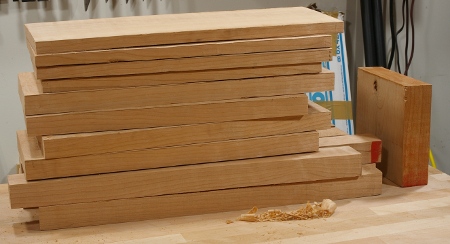
One of the projects I’m starting now is a small bookshelf prototype that I’ll use to guide my way through building later versions. I’m in the process of milling the wood, and to make efficient use of the wood, I decided to resaw 4/4 boards so that I can use one slice for the sides and shelves, and the other slice for a panel in the rear of the bookshelf.

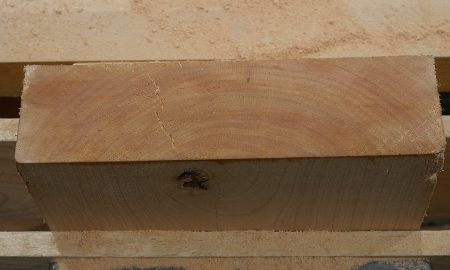
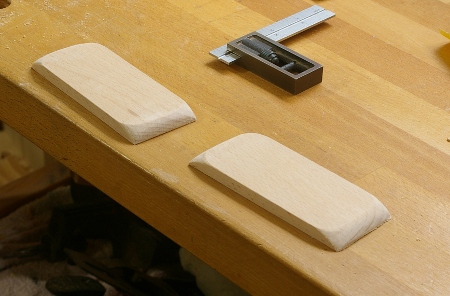
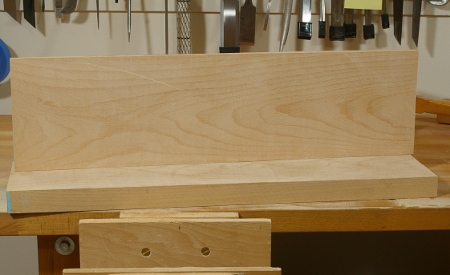
So it’s the first real-life use of my frame saw. It does fairly well; here’s a roughly 1/4″ slice that came off one board (this is Yellow-poplar/Liriodendron tulipifera):

panel_slice

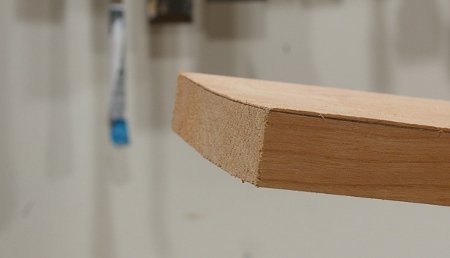
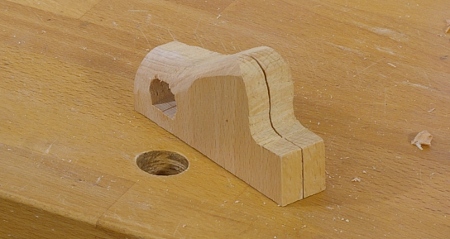
The upper left looks slightly ugly in this shot, but it’s actually just two passes of a plane from totally flush. The result is actually quite good–very flat, no wandering of the saw. I seem to run into difficulty at the end of of the board, and I’m still trying to figure out ways to make that easier. Unfortunately, what didn’t help was the tension on my frame saw being too great for the hardware that I made to hold the blade in place, causing it to tear apart on one side:

frame_saw_broken_hardware

Yikes. Well, okay, so I just chopped it off and remade the piece. I think this part is a little weak because of the recesses I filed for the itty bitty screws that I no longer use. I’m still not entirely happy with the arrangement, but if it holds, I’ll change my attitude.

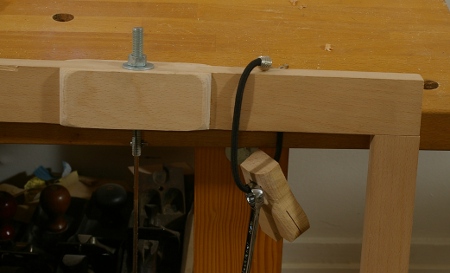
Speaking of attitude, mine towards my front vise has been one of complete irritation for the past several months. I’ve had the endcaps held on at the very tip with screw inserts in the center with a machine screw to hold the whole thing in. Unfortunately, the insert kept coming out (because inserts don’t work well when inserted parallel to the grain, duh), the cap would come loose, and the handle would fall out of the vise. Of course, it would always fall out at an appropriately inconvenient time.

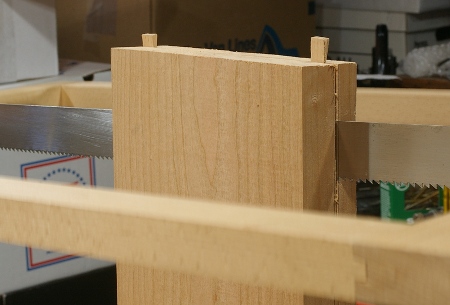
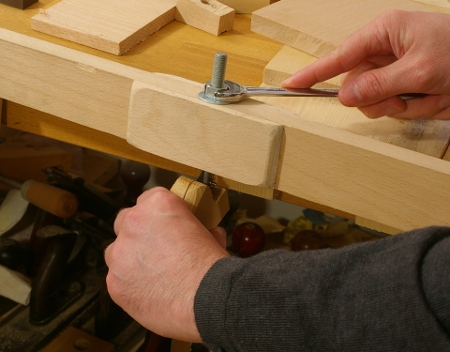
This was happening on only one side of the vise, and I finally fixed it for good today by relocating the insert to the side of the handle instead of the tip (you can see the hole in the tip at the right where the screw used to be):

vise_handle_cap_secure

I suppose that it’s fixed “for good” until this happens to the other end of the handle and I have to do the same thing there. Sigh. Why it took me so long to fix this is beyond me.

Tags:

Frame Saw: Important tweaks

After a bunch of sessions with the new frame saw, I determined that it wasn’t working the way it was supposed to. It didn’t cut quickly, the kerf was too wide, and the blade wandered all over the place. I suspected that more than one thing was wrong, and I had a few ideas.

First, I caught on to the fact that the blade wasn’t really sharp, although it had the appearance of being sharp. I really need to learn that if the guy who made your saw doesn’t have a name like Wenzloff, it probably isn’t sharp, so you should save yourself a lot of trouble and sharpen it before using it. Groan.

I reshaped the teeth to have a fairly aggressive zero-degree rake angle, and took a considerable amount of care when sharpening to make sure that the tips were all very close to the same height. The result looks like this:

frame_saw_new_teeth

When doing this, I realized two additional things about this blade. First, it had way too much set, and second, the saw plate is a little thicker than I thought it was. This latter point was a big deal, because it seemed like the tips of the points originally were chamfered or slightly rounded. I couldn’t see this originally, even with reading glasses. And obviously, it makes a big difference in use, because, as I find over and over again, sofa-shaped blades don’t cut wood very well. (I wonder why.)

The difference in sharpening alone was really remarkable. Because the process removed most of the set, it made for a wonderfully thin kerf, and therefore, it tracked a line much better, even though the blade wasn’t terribly taut. And the more aggressive and sharp teeth cut much faster and smoother.

Now, the second problem I was having was that I couldn’t increase the blade tension too much, because the little screws that I was using to hold the blade in place were snapping due to the tension:

frame_saw_failed_pins

Yikes. So I cut and filed a few brads for this purpose:

frame_saw_new_pins

Now that there’s enough tension, I don’t have a problem with the blade twisting around (thanks for the pointer, Dan). The only issue I have now is that it’s difficult to keep the blade straight when tightening it up. Christopher Swingley uses a wrench on the flats, which seems like an idea that might work.

After making these two changes, this saw really seems to be on the right track, and I think I’ll be able to do decent work with it. I already sawed out some 3/16″ slices from a couple of smaller boards (without even marking!), and they came out great.

There always seems to be a lot of discussion about frame saws, and what kind of blade is appropriate. Tom Holloway’s saws use thin blades, and I can attest to how effective they are, having played with them. Bob Easton uses thicker blades from old Disston saws and that seems to work too. It seems to me that there’s more than one way to skin a cat.

A case in point here is what I edited in as a note in my last post, that there’s a version of a Japanese saw, the “oga kobiki” or something, that has a gigantic blade, but seems remarkably easy to use. Check out the pictures in this link if you haven’t yet. You see how that tiny woman is using that huge saw? Look at how beautifully the cut turns out. Oh, how I would love to examine that saw that they’re using.

So it seems that if the kerf is even enough–not too wide, not too narrow, of constant width, and straight–it doesn’t matter how big your blade is, as long as it’s slippery and sharp.

I don’t think this is going to be the last blade for this frame saw. I’ve got some ideas that might make it faster. Let’s just say that the gigantic teeth on the Japanese saw got me thinking.

I also got to thinking that I might need to do something about my saw vise. It works pretty well for small saws, but when you start to file the big teeth, it shakes too much. What to do here? Finally make my own? Cave in and get one of those new Gramercy saw vises? Find someone who has a good one and mug them?

Tags: ,

Frame Saw: Push or Pull?

One of the interesting features of a frame saw is that one can use it as a push saw (with enough tension on the blade) or as a pull saw. Which is more appropriate, if there is such a thing?

I thought about this while in the process of resawing some beech, a bear of a process when the board is a 13.5″ wide slab. I had the saw in at roughly 45-80 degrees and it seemed to me that it was much faster pulling than pushing. What could have caused this, other than not enough blade tension?

As pretty much anyone will tell you, during ripping, your saw teeth are acting as little chisels and are hopefully shaped as such. But then wouldn’t the factor of grain orientation come into play?

  • When pushing into a board with the tooth side of the blade at an acute angle to the board, you are generally sawing with the grain, as you would with a plane.
  • When pulling out of the board, you are sawing into the grain, invoking tearout.

If you tear out, is that a bad thing? It seems to me that it would be faster because your saw would be continuously digging itself into the fibers. Of course, it would be tougher work. Would it also help avoid tracking the grain?

Think of the Japanese timber saws (stuff like the Kobiki Nokogiri or whatever its name is) — these are notoriously quick pull saws.

Well, I think I’ll do some more sawing to see what I like in practice. Probably with something other than a 13.5″ wide chunk of beech, though.

[Edit: Check out this blog post that a friend dug up for me. They're ripping chestnut logs in a demonstration of traditional techniques, letting lots of people try. The big saw is called "Oga Kobiki" (大鋸) or "Daigiri" or something like that. Check out the angle they're using in the wood versus the rake angle of the teeth.]

Tags:

Frame Saw: Almost Finished

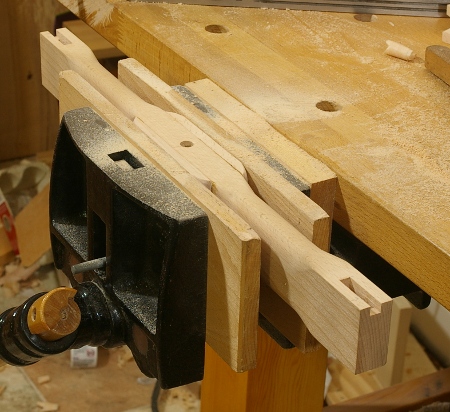
To make the handles into one end of the frame saw, I first marked out the length-wise dimensions with a pencil and the cross section limits with a marking gauge (hard to see in this photo, but they’re there):

frame_saw_handle_markout

Then I set to work shaping the handles. I used my Shinto saw rasp first. I really like that tool: cheap, innovative, and highly effective.

frame_saw_handle_rasping

To finish shaping, especially at the edges, I used my Gramercy saw maker’s rasp. Then I smoothed it out with progressive grits of sandpaper on a dowel, starting at 120 grit. Finally, I hand-sanded to 320 grit, and called it ready:

frame_saw_handle_shaped

Then I assembled the saw with the newly-waxed blade:

frame_saw_assembled

So far, so good. I tried it out and quickly found that I will need to do some version of the trick that others have done to keep the blade square. It does tend to slip around. It also seems like it’s necessary to practice technique, because this thing does have a tendency to slip out of the kerf because the blade is so thin.

And then there’s the issue of workholding. Hmm. Clearly there is more work to be done here.

Tags:

Frame Saw: Joinery and Hardware

After looking at lots of frame saws that a lot of other galoots have made (not mentioning any names here, Mssr. Isola), I decided to make my own for resawing. Well, I had decided to make my own a long time ago, but never got around to it until now. About a year ago, I ordered the blade (a Wilhelm Putsch blade, about 5 teeth per inch), and set aside a piece of beech. Then I proceeded to do nothing else on the project until last week.

After cutting the pieces out and milling them to size, I cut the joinery. There have been many styles for the frame joints, but most people do mortise-and-tenon joints that aren’t glued (the blade tension keeps the saw together), so I did, too. I decided to make the joints haunched, because in theory, that kind of joint resists twisting better than a plain blind joint. Also, I’ve never made one, so I figure I’d better get down to the business of screwing them up.

And I screw up I did, slightly, on the first two. On the first one, I blew out the side of the mortise when chopping it (it was too close to the end, 1/4″). Nothing a little glue won’t fix. On the next one, I cut the tenon too loose, which doesn’t matter on a joint that I’m not going to glue, but still.

The next two came out perfectly, though:

frame_saw_joint

Then it was time to make the hardware to hold the blade. I didn’t deviate from the way others have done it. I used a 5/16″ carriage bolt for one side (bottom in the picture) and a section of threaded rod (top in the pic) for the other:

frame_saw_hardware

The steps I took were as follows:

  1. Filed the threads flat and four-square at the end.
  2. Drilled the hole that will hold the blade-holding pin with a Millers Falls #5 eggbeater.
  3. Cut the blade slot with a Bahco junior hacksaw (slowly, to keep the hacksaw blade from wandering around). The kerf is almost a perfect match for the blade.
  4. Cleaned up the areas around the slot with a small tapered file.
  5. Cleaned up the slot with some folded sandpaper in the kerf.
  6. Cleaned up the tip.
  7. Discovered that the little bolts that I was using to pin the blade were a little too short for the little nut to fit.
  8. Filed recesses around the hole in the big bolt so that the little nut could reach the little bolt.
  9. Cleaned up the tip again.

One little tip when you’re filing any kind of thread: Keep a nut on the inside of the filing area. After each stage of filing, take off the nut and put it back on again. This cleans up the threads, although for this project, it doesn’t really matter for the carriage bolt side.

The saw is functional now (I’ve done a test cut), but I’m not quite finished yet. I’m currently waxing the blade and I also need to shape handles into the ends.

[Edit: I have ditched the wingnut in favor of a regular hex nut tensioned with a wrench. The wingnut does not provide enough tension.]

Tags: