Rip Panel Saw: Sawplate Modifications, Taper Grinding Musings

Sometimes, you gotta learn the hard way.

I started work on the sawplate by cutting off a bit of the tip so that the hang hole was off and there was a reasonable depth to the blade at the tip. So far, so good–no trouble encountered there.

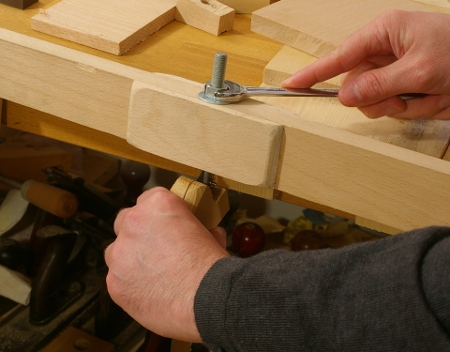
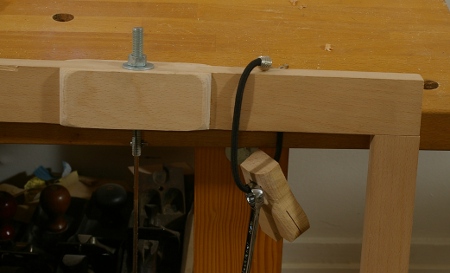
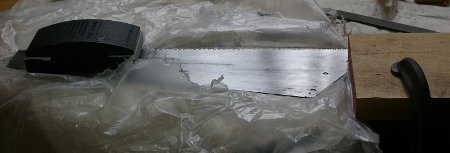
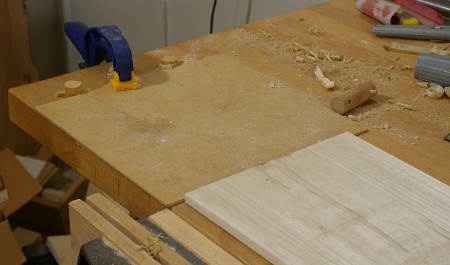
Then I removed the lacquer from the blade with this clamping arrangement and Norton 3X sandpaper:

That, too, worked pretty well, and to my surprise, it removed .001″ of the thickness of the blade. That got me thinking that, hey, maybe I could remove some of the steel with this sandpaper, too. Maybe I’d even be able to taper it!

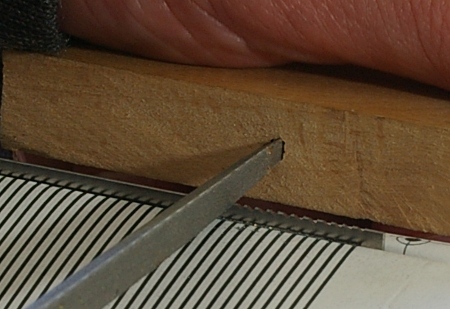
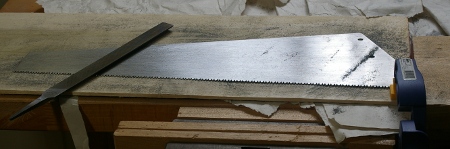
Well, that turned out to be an idiotic idea. Spring steel is still pretty hard, m’kay? After wasting who knows-how-long to remove maybe .0005″, I decided that maybe I’d try drawfiling it:

That sort of worked. After expending a ridiculous amount of effort, I’d knocked the plate down to about .032″ (from .035″ originally), and I got the tip of the top tapered down to about .029″ (maybe). I decided to call it finished.

Please don’t try this yourself. It was an incredibly stupid idea, and I’m never going to do it again. If you want a nice blade, I suggest this approach:

  1. Start with the blade thickness that you want in the first place.
  2. Use something like a belt sander with Norton 3X belts if you want to taper grind it. (And remember to use proper safety equipment–a respirator mask, safety glasses, gloves, and something that will hold that blade in place with no chance of letting go.) Not that I’ve tried this, but it’s hard to imagine any way that this would be worse than what I did.

Speaking of taper grinding, I discovered something about it when working on this project. There is a fair amount of smoke-and-mirror action going on with some of these old taper-ground blades. Most full-size handsaws seem to go from a full thickness of about .040″ to around 0.030″ along most of the significantly-tapered tapered part of the top, then it drops down to about 0.025″ at the very tip at the top (maybe the last half-inch). So that’s about 25% thinner along most of the top and I can see where that could be helpful in use. But the teeny bit at the very end? Meh. You hardly ever even have that part in the kerf, anyway.

My Pax saw has similar taper grinding as on the old saws except at the very tip. It appears much thicker than the old saws, but measuring reveals that it’s about the same. What’s going on here?

The original saw that I’m copying has less significant taper-grinding along most of the top–its cutting side is about .031″ and it’s ground to about .028″ along the top. That’s about a roughly 10% difference. However, it looks a lot thinner up there, and after a long time, it dawned on me that they’ve rounded off the top of the saw a little to make it look more elegant. It was the same thing with the older saws, and that’s why the Pax doesn’t look like it’s been taper-ground as well, even though it has.

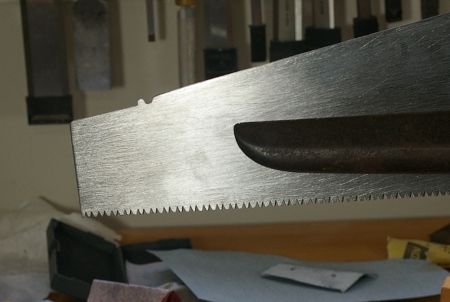
At this point, I was really starting to lose my mind, so I did the same rounding operation on the top of my new sawplate, and guess what? It now looks like it’s been “seriously” taper-ground. Continuing the absurd voodoo practice, I filed a nib onto the thing:

Now I’m almost ready to form and sharpen the teeth. I was originally going to file off all of the teeth and start new ones. However, it seems that the original teeth on this saw were set at 8TPI, which happens to be about what I want on this thing (it also matches the original), so maybe I don’t have to go the whole way.

The handle varnishing is almost done, too.

Rip Panel Saw: Choosing a Sawplate

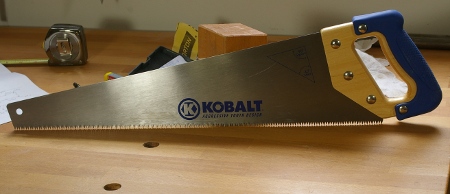
While the handle is in the varnishing stage, I’ve been worrying about how to approach the sawplate for the new saw. Being the cheapskate that I am, I have been considering using the plate from this thing that I picked up for a song and a dance some time ago:

The basic shape is right, but of course, I’d cut the tip off to make it look halfway normal, mill off the teeth, and cut new ones, and do whatever else is necessary to get it fit on the handle.

The trick to all of this is the thickness of the plate. It’s kind of a tricky business, because all of the old saws were taper-ground, and you won’t find a cheap saw these days that is. So I’d be giving that up, but I don’t have any old saws that I can cannibalize anyway.

Furthermore, until now, I really didn’t know the thicknesses of any of the plates that I was working with; I was only able to sort of guess by looking at them. Well, that all changed when I finally got off my butt and bought a micrometer. Why I didn’t get one before, I’ll never know. It’s really taken a lot of the guesswork out of a lot of stuff.

I’d been wondering about this because I’ve got saws that turned out in certain unexpected ways due to this, and I really didn’t know about it before. For example, my crosscut carcase saw works wonderfully, but a rip version of it didn’t turn out the way I wanted it to. The plate on those two saws is .0263″, but you’d really want something more like the 0.020″ thickness found on most dovetail saws.

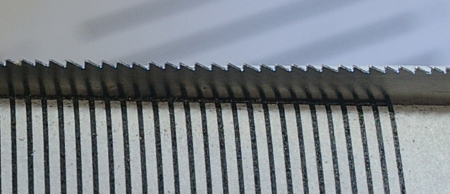
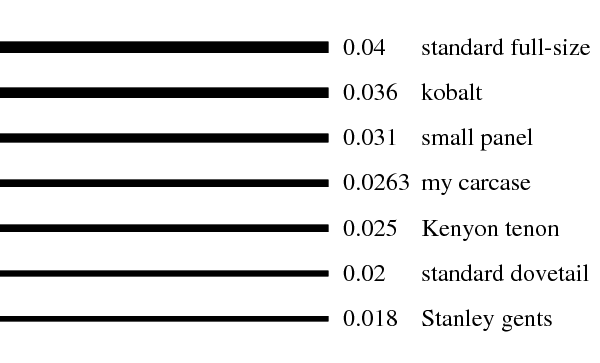
What’s .0063″ of difference? Well, one way to think about it is that it’s 31.5% thicker, which is pretty significant. In theory, you’re cutting 31.5% more wood, and so it’s 31.5% more work to do it. (This does not hold for a crosscut saw, where you are slicing fibers out instead of scooping shavings.) You can also look at it visually; take a look at the following image that I just cobbled together as a PostScript program:

The difference between .020 and .0263 looks pretty striking here. These thicknesses are at the cutting edge. I have the measurements for the tops of the saws that are taper ground, but I’m going to set that aside for the moment.

As you might have noticed, I put labels on this image. Of course, after I got my micrometer, I obsessively measured all of my saws. I don’t have a Kenyon saw, but it’s listed here as a representative for a big tenon saw (the Wenzloff versions have .025″ plates).

There are some surprises, such as that Stanley dovetail saw with the gents handle. This is a relatively new one that I picked out of a basement. I never bothered with it because I already had the Crown equivalent (.0205″), but you can see that it’s quite thin! This is the saw featured in Korn’s book, and it should be pretty obvious that if you’re willing to learn how to sharpen it, it will give you experience with a thinner plate and should work just fine. It’s no wonder he has no trouble recommending it.

So getting back to the question at hand, is the lovely “Kobalt” plate going to work? I think I’m going to give it a shot. It’s about 16% thicker on its cutting edge than the original that I’m working with, but that doesn’t seem that bad (and some of this thickness may be lacquer). The thickness of the original is a little unusual anyway; full-size saws are about 33% thicker. The only blade I have that’s close is my frame saw blade (0.029″), and, er, that’s not gonna work.

Then there’s the matter of taper-grinding. Should I try this? I’ve got sort of an idea of how I can do it without a power tool (although if I were sane, I’d ask to use someone’s belt sander). Would that warp the plate? Hmm.

Rip Panel Saw: Handle Shaping

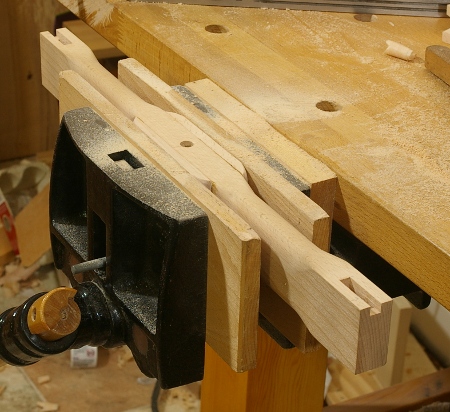
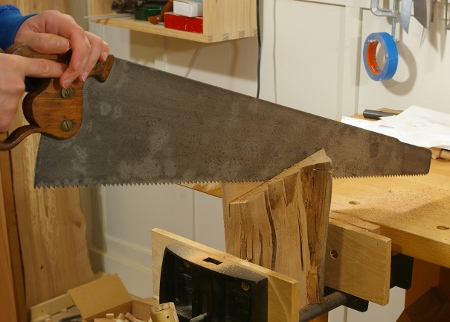
Available time to work on this saw comes and goes, but it’s getting somewhere. After coming up with the template, I grabbed the piece of madrone that I’d worked on before (and made the nightstand drawer pull from) and thought that there might be enough of a solid section to make this handle. I started by ripping down the sides (you can’t split madrone as you can oak, because it does not split terribly straight). I came up with the following ridiculous-looking, yet surprisingly effective workholding arrangement:

I thought that it might be a pain to saw, but it wasn’t that bad. I also have a newfound respect for my front vise. Before long, I had a little board milled.

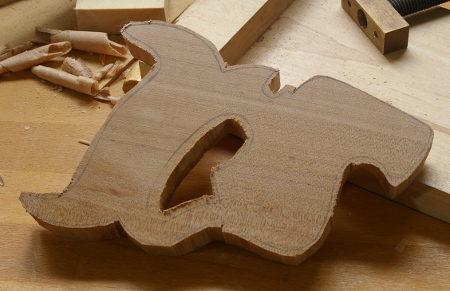
The big question still remained about the checks. I suspected that I would be able to position the handle cutout where the cracks would not extend, so I traced out the pattern:

Yes, this would be unaffected by the check on the top of this photo, but I didn’t know how far in the one at the right end extended. When it was all said and done, a small amount does remain, but its location is inconsequential (details of that might be in a later post).

I cut out the rough template with the coping saw:

As I was doing this, I started to suspect that the shaping process would be somewhat more difficult than my previous handles. There was something about this wood that just felt different.

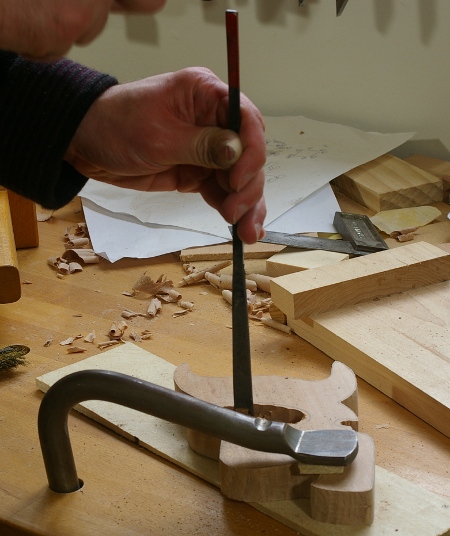
I made quick work of getting down to the lines on the outside with my saw rasp and sawmaker’s rasp, but the inside was a little trickier because there wasn’t much space to work. I started to wish that I had an inchannel gouge, and after a minute or so, I realized that I did have one, that Taiwanese one I’d bought during the holidays.

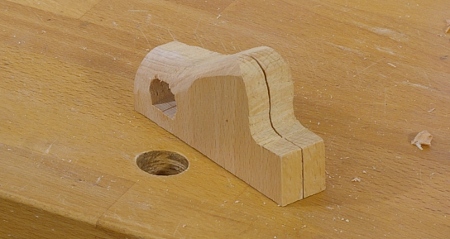
I don’t have a proper mallet for it, so I just banged at it with a marginally not-uncomfortable chunk of the madrone cutoff, and this got the job done (though I think I want a proper mallet):

It turns out that this is a really good gouge! (The ones with the red at the ends are supposed to be the better ones.) After all of this chopping, there were no nicks and it seemed just as sharp as ever. I’ll have to pick up a few more of those on my next trip.

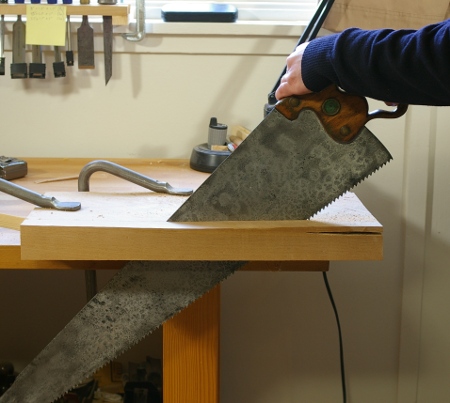
Then it was off to shaping. That, as I suspected, was kind of a pain. Madrone cuts easily enough but its sawdust is really fine and clogs everything quickly.  I ended up using a lot of 60-grit Norton 3X sandpaper to fine-tune the shape because that stuff doesn’t clog so easily. I used a 1/4″ chisel for a lot of the nooks and crannies and imagine that some outchannel gouges would have been handy. But I did eventually get it done, and then cut the kerf for the blade using my trusty gents saw:

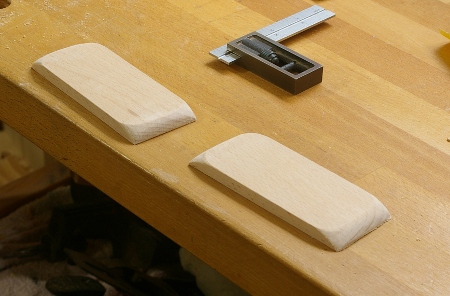
I also tapered the front with this saw, but made some modifications to the original. Here’s the new handle next to the original:

The new one is tilted slightly counterclockwise to the original in this shot, and there are some perspective issues, but you can see some subtle differences, some intentional, some not quite so. The bottom is a little thicker and the cheek has a little bit more surface area. The front is tapered a little differently. The original’s tapering was uneven, so I decided that I would smooth it out a little on mine. The unintentional change is how the back of the “lamb’s tongue” isn’t as deep as on the original. I can’t figure out how this happened, but I’m not going to bother changing it. (If I didn’t like the way that it looked, I’d change it, but I do like it.)

So now, I suppose I should put some holes in there for the screws and varnish the thing. And I happen to be already varnishing the nightstand at the moment–how convenient.

Rip Panel Saw: Handle Template

I’ve got the nightstand drawer in the clamps, put the first coat of varnish on the frame, and sized up the top. Now with just varnishing left on that project, I have been given license to do whatever I want for the next two months while I do the finishing (and wait for the varnish to dry) on that project.

Aw yeah. I’m gonna make me some more tools.

The list includes three saws. One of these is a little panel saw filed rip that I’ve found myself wanting several times in the past. There’s another reason for this–I’ve got an old Disston panel saw, probably a No. 7, that I really like, but won’t use because the handle is loose (due to a crack), the blade’s slightly broken at the end, and it’s kind of rusty. The handle on this thing feels incredibly comfortable in my hand and I’ve always wanted to make one.

I had a little time today to work on the template for the handle. I dug out an old PostScript program I wrote that draws a grid, barbarically converted it from metric to imperial units, and printed it out. Then I placed it on a wall next to a shelf, put the saw on a shelf, and took a photo (dumb note: this is one of the very few on this site where I used a flash):

Hey, let’s look at that medallion really quick:

The Disstonian Institute says that this is from around 1874-1875.

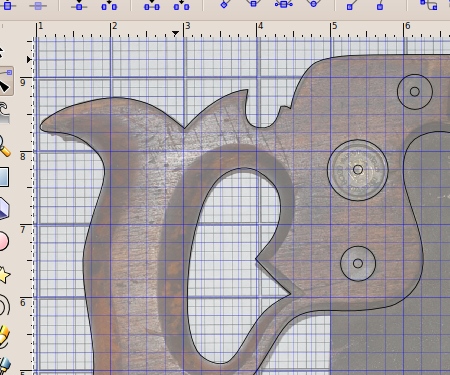
Getting back to the task at hand, I loaded a cropped version of that photo into Inkscape, scaled it so that the grid matched the scale of the page, then made that layer transparent and laid out the pattern on top as vector graphics:

This was a lot easier than I remembered it being in the past. It only took about 20 minutes to get it set.

Normally, I would try to simplify old-fashioned lines on a handle because I like to have a somewhat more contemporary design (for example, ease out that angle on the inside), but I like this saw so much that I’m going to try to clone it as faithfully as possible. That’s not going to stop me from using my usual furniture connectors as the hardware, though.

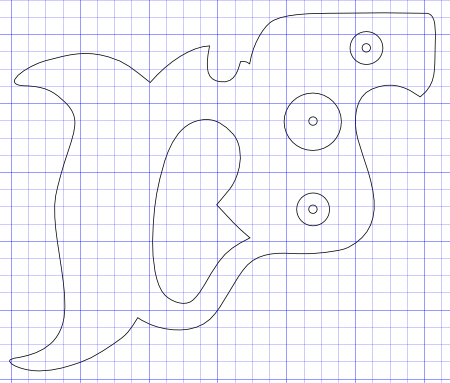
With the lines set, I printed out the template:

Now I have to cut it out and trace it onto the piece of wood that I’ll use for the handle. The trick is that I don’t yet actually have a piece of wood. Okay, gotta work on that.

[Update: This template is now available on the Plans and Guides page.]

Nightstand: Resawing Legs With The Frame Saw

Even though I have not yet completed the cutting list for the nightstand, I do know that I will need four 24″ long legs that are 1.25″ square. I had meant to get the stock milled for this sooner, but it’s been a busy week. I finally completed the flattening of the 7″ wide 8/4 board segment that I plan to use today, and then faced the task of resawing this thing into the piece for the legs and a panel for one of the sides.

It’s been a few months since I last did any resawing, and I wasn’t particularly looking forward to it, given how much work it’s been the last few times. But this time was a little different (otherwise I wouldn’t even be writing about it).

I wanted to try out the techniques shown in a few videos of those magnificent Japanese sawyer’s saws. They use them mostly perpendicular to the grain, letting the huge area of the saw register a very smooth cut through the wood. I can’t do this completely with my frame saw because its blade is not deep enough to register so well, but I could at least try to do it partway.

I started by the diagonal cuts along marked lines that are necessary in order to get a square cut started. Further cutting along each side at a very slight diagonal established a somewhat shallow kerf on side. Then, to connect the two kerfs, I clamped the board upright in my front vise and went at it almost perpendicular to the grain (I’m pushing it here):

As noted before (by several folks), it is really important to tighten up the blade to a very high tension in order to keep the blade from binding up and cutting a curve. From time to time, I would reach the end of the kerfs I’d cut on each side and I’d have to extend them. I think that this actually took more time than doing the bulk of the sawing. In fact, most of this went very quickly because the saw followed the kerfs better than before.

I sawed all the way down to a spot about an inch away from the end, and then wondered if there was any better way to finish off the cut with the vise. I then did a very silly thing: I clamped the board in upside down, with the saw upside down, and pushed the saw up from underneath to finish it off. Don’t do this; it’s ridiculous. Afterwards, I realized that it would have been a lot easier to clamp the board flat to the bench with the uncut end hanging off the end, and just work the saw sideways for that last little bit. There are other setups that I’ve seen that do a better job still, but I don’t have the resources for that yet.

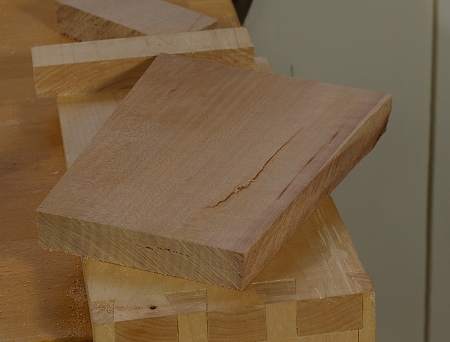
So I was finished with this bit:

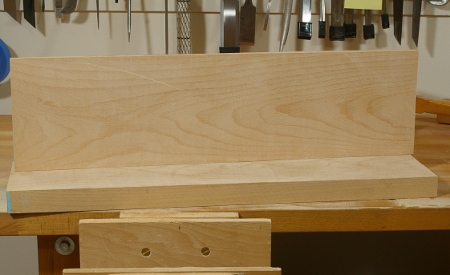
Not bad, not perfect, though. There’s one saw mark on the top center-left, but it’s very shallow (one pass of the fore plane will remove that).

I’m starting to figure out that my frame saw is pretty good for boards that aren’t so wide. This was a 7″ wide piece of beech, and that’s probably about the maximum that’s comfortable with this saw. If I ever build another frame saw, it will have the following changes:

  • Longer frame and blade to handle wider boards better.
  • Wider blade for better registration.
  • Much larger teeth.
  • Improved hardware for attaching the blade. I’m not sure how to go about that just yet, but I do think that it ought to be bigger than the stuff I currently use.
  • Yeah, a saw bench would help a lot, too.

That said, what I have is workable for what I do now, and I do have to finish this project in a reasonable amount of time. (I think it’s supposed to be done by the end of August.)

Stool: Plan, Milling Stock

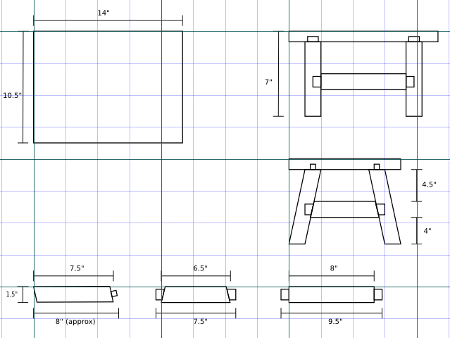
Now that the bookshelf prototype is glued up and ready for varnishing, I’m able to move on to my next project, which will be a short stool, essentially a single-step stool similar in spirit to the one that my great-great grandfather made. It won’t resemble his in size, wood type, or joinery; it will be adult-size and not use nails. Here is the general plan:

[Update: The plan is now available on the Plans and Guides page.]

I’ll make the whole thing from a wide piece of beech that I got last year. The top has already made an appearance here, although back then, it wasn’t flat, uniform, and smooth, as it is now. This board is 8/4 stock, but unfortunately, part of one side of a 2.5-foot section isn’t usable. After looking at the requirements for this project, I determined that this section contains enough usable wood, though I have to be careful where I cut. The legs will be 1.5″ square, and the stretchers will be 1.5″ x 1″.

Milling the legs and stretchers is a little more work than I expected. Because the board is quite cupped, and also because I’m trying to avoid some nasty parts of the board, I decided to mill each piece to thickness individually instead of the entire board at once. I’m first ripping out sections like this (notice the wedge in the kerf at the end):

You can barely see the nasty stuff I’m trying to work around in this shot; the discoloration at the upper right and a previous (aborted) attempt at trying to slice that stuff off.

After ripping, I have to flatten one face, square an adjacent face, saw some more, and plane some more. So far, I have one leg and one stretcher four-square. If I didn’t have the big saw, I probably wouldn’t even be that far.

Bookshelf: The 60-Year Dovetail

I’m slowly making my way through the prototype bookshelf project. After realizing that my widths were all wrong, I had to spend some quality time with my rip saws and jointer plane to fix all of it, and I was able to do that during what little time I had this weekend.

So then I decided to get started on the dovetail joints for the top, and let’s just say that my dovetails are not the famous five-minute variety. I don’t get a lot of uninterrupted time in the shop these days, so I just cut whatever I can, and stop when I need to. On Monday, I laid out the tails and cut them. Yesterday, I only had time to finish cleaning the waste between the tails and mark out the pins. This morning, I had enough time to cut the pins and finish the joint (and mark out the tails for the next joint). So it may not be the 60-year dovetail, but sometimes it seems like that.

However, the story is not a sad one. For one, the joint is perfect; the only thing left to do here is plane off the proud excess at the ends of the tails and pins:

Another bright spot is that it went off without a hitch, even on pain-in-the-butt yellow-poplar sapwood (the lighter bits on the right). Saw, chop, and test-fit. The pins fit right off the saw; no paring was required on the sides of the pins. Thinking back to the first dovetail joints I made, it took much longer to cut joints that did not turn out as well. My speed is improving.

I’m back to using my cheap Crown gent’s saw, still with the same touching up of the teeth that I gave it when I first got it (slight jointing, filing with a needle file, slight stoning on the sides to remove some of the set, and wax). It works fine, though I can’t imagine how bad it would have been if I hadn’t tuned it. I am still plotting out the dream dovetail saw that I will make one day, but I’m too busy with furniture projects right now to get tied up with making another stupid tool, and honestly, it’s just not that important.

Sometimes I think of what could possibly make things move a little faster, and I came to the conclusion that some operations are actually going quickly but some not so quickly.

The fast ones are:

  • Sawing down the tails and pins
  • Removing the bulk of the waste
  • Test-fitting

The stuff that seems to take a little longer:

  • Laying out the joints
  • Paring down the final little bits in the tail and pin troughs

Now, I know that the paring could go a little quicker if I just bothered to make a pair of skew chisels. I really should get on that case some day.

What about laying out the joints, though? I do this mostly by eye now, marking out “what looks good” (to me, at least) for the tail spacing, then using a square and T-bevel to mark the lines. This works and it is St. Roy- (and others) approved. But it’s not fast for me. I can mark the spacing quickly enough, but lining up the T-bevel to the mark on top always seems to take a little extra time. A dovetail template could save some time, because you can register it to your marks at the top quickly.

But then again, we’re talking about a savings of only about two or three minutes here. And I don’t think it’s worth getting yet another tool for that at the moment. Furthermore, I can’t just arbitrarily pick the angle I want, as I do now. I know that’s been said a million times before, but I do think it counts for something.

Frankensaw; Saw Sharpening Guides

I’m finally done with sharpening the last saw on my to-do list. This and the one in my previous post were both acquired at an estate sale over in the Sunset district last year. They’re both Disston No. 7s, but both have been rehandled. The first one I worked on had some sort of modernish handle on it. The one I just finished has a No. 12 handle.

Someone must have liked these saws. They were both rust-free and had pretty good visible etches. Unfortunately, the sharpening on them was crap. The No. 7/12 Frankensaw needed serious jointing (and therefore, serious tooth reshaping) before it could be pointed.

But once at the pointing stage, things went pretty quickly in spite of it being a 26″ saw with 8 teeth per inch. I used a 10 degree fleam angle this time, and used a roughly 10 degree slope on the gullets as well. Here’s a shot of the sharpening in progress:

This picture shows one of the issues that often comes up when sharpening crosscut saws that I’ve been talking about recently, and that is, that the shape that the tooth appears to be can be misleading. Look at the teeth on the right side of the saw in the preceding image. See how they look kind of spindly? It’s a trick of the reflected light. Here’s a close-up, where you can see the reflections and the full tooth profile:

Obviously, there are some uneven spots here, too, like the second-to-left gullet, but those were taken care of on a second pass. but the point is that you have to be careful about what you see. Just be consistent with the angles you work at, look at the tops of the teeth to see when you’re done.

Here is the saw in its finished state:

You can see my fleam guide in the photo of the work in progress. I worked a little on the code for this before starting this saw. My previous version required you to use two different cutouts to sharpen each side of the teeth. That was kind of stupid, because you can see only one side of it at a time. So I reworked it.

Update: I now recommend that you use the versions that are on the Plans and Guides page rather than the following, but I’m not going to remove these any time soon.

Here are PDF versions for:

If you know how to use PostScript, ask me for the source code; you can put in any fleam angle you like. (I haven’t figured out how to trick WordPress into letting me upload a .ps file without doing something stupid like archiving yet, sigh.)

Also, I have a PDF tooth pitch gauge (toothgauge) that you might be able to use at some point.

My Sloped Gullets

Leif over at Norse Woodsmith did a recent post on sloped gullets. Strangely enough, I’ve been working on restoring a couple of saws lately, and about the time he posted, I was starting to sharpen one of them, an old Disston No. 7. I finished this morning and decided to take a photo of the result. Unfortunately, I don’t have a macro lens, so I can’t get much better than the following shot, and also unfortunately, I don’t think the angle is very good, because you can’t really see the bottom of the gullets too well:

In any case, take a look at the bottom of the brightly reflected edges, and you’ll see that the rear is higher than the front, especially on that tooth all the way to the left. This shot was taken straight from the saw coming off the file, so you can see some burr here and there. You can also see how difficult it is to judge the height and shape of the teeth here. In this shot, it looks like the teeth set towards the camera (the all-dark ones) are a little bit lower than the ones set away, but in reality, they’re all the same. It really is easier to tell by jointing the teeth and filing until the flats are gone.

I’d mentioned in a comment on Leif’s post that the angle I used for fleam and slope was not that great. On further inspection, it seems to be moderate. The fleam angle is 20 degrees and the slope is about the same. I think a 10-15 degree fleam and slope would be easier to file, and I plan to try it out on the other saw I need to sharpen.

All of this theory is useless if it doesn’t work in practice. Here is a test cut in beech:

It’s about what you would expect from a 6TPI saw that’s 26″ long. The important part is that it belches sawdust profusely when sawing, and with a controlled cut, you don’t get much tearout. And it’s always nice to get a 110+ year old tool working again.

Frame Saw: Resawing panels, repairs

One of the projects I’m starting now is a small bookshelf prototype that I’ll use to guide my way through building later versions. I’m in the process of milling the wood, and to make efficient use of the wood, I decided to resaw 4/4 boards so that I can use one slice for the sides and shelves, and the other slice for a panel in the rear of the bookshelf.

So it’s the first real-life use of my frame saw. It does fairly well; here’s a roughly 1/4″ slice that came off one board (this is Yellow-poplar/Liriodendron tulipifera):

panel_slice

The upper left looks slightly ugly in this shot, but it’s actually just two passes of a plane from totally flush. The result is actually quite good–very flat, no wandering of the saw. I seem to run into difficulty at the end of of the board, and I’m still trying to figure out ways to make that easier. Unfortunately, what didn’t help was the tension on my frame saw being too great for the hardware that I made to hold the blade in place, causing it to tear apart on one side:

frame_saw_broken_hardware

Yikes. Well, okay, so I just chopped it off and remade the piece. I think this part is a little weak because of the recesses I filed for the itty bitty screws that I no longer use. I’m still not entirely happy with the arrangement, but if it holds, I’ll change my attitude.

Speaking of attitude, mine towards my front vise has been one of complete irritation for the past several months. I’ve had the endcaps held on at the very tip with screw inserts in the center with a machine screw to hold the whole thing in. Unfortunately, the insert kept coming out (because inserts don’t work well when inserted parallel to the grain, duh), the cap would come loose, and the handle would fall out of the vise. Of course, it would always fall out at an appropriately inconvenient time.

This was happening on only one side of the vise, and I finally fixed it for good today by relocating the insert to the side of the handle instead of the tip (you can see the hole in the tip at the right where the screw used to be):

vise_handle_cap_secure

I suppose that it’s fixed “for good” until this happens to the other end of the handle and I have to do the same thing there. Sigh. Why it took me so long to fix this is beyond me.