A-Lumberin’ We’ll Go

I finally made it to the lumberyard today. My official excuse was that I was waiting until I fitted the roof rack to my car. I did that last weekend, and then today, I decided that since I don’t have any fancy needs right now, that I’d just have it chopped into 5-foot lengths, which do fit into my car. That’s a hell of a lot easier than strapping boards to the rack.

This was pretty much my first experience at a place that actually has a lot of hardwood. The English spoken there was kind of spotty, but they were nice enough, and after a lot of back-and-forth, I’d selected a few FAS roughsawn yellow-poplar boards, and one nice roughsawn piece of cherry.

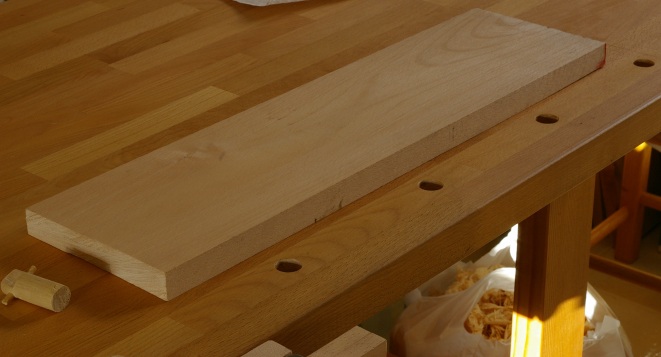
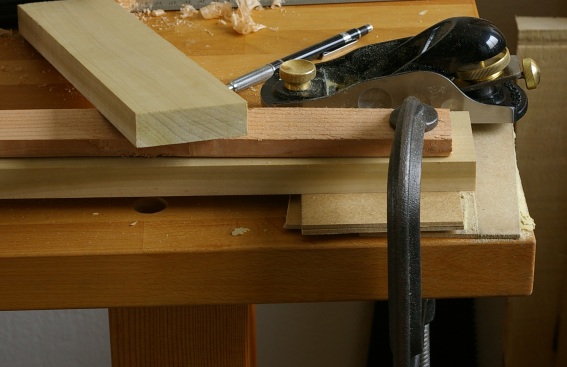
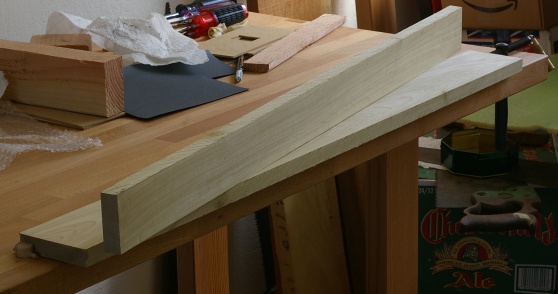
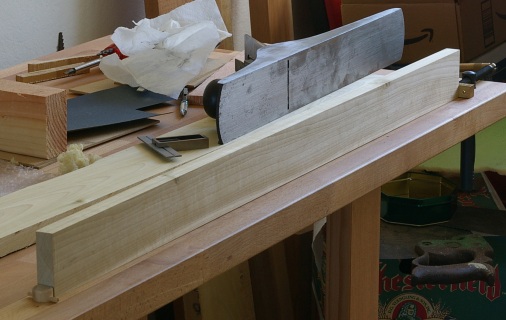
Roughsawn wood is not exciting for most people to behold.

That’s the cherry on the left, and one of the pieces of poplar on the right. However dull this looks to most people, though, it’s thrilling to me. And somehow I feel like I’m on some sort of slippery slope now, because my downstairs storage now contains a bunch of boards, just waiting for me to take a whack at them.

So now I’m ready. The only excuses I have for not seriously practicing joinery are either that I’m being lazy or I’m doing something stupid, like playing a video game or doing laundry.

In other news, I finally got a low-angle block plane. I had a prepaid visa gift card to blow, so I blew it on the offering from Lee Valley/Veritas. It was not a trivial expense.

Some people complain that it “doesn’t look traditional.” Traditional compared to what? The cast iron planes that looked all non-traditional in the 19th century? Yeah… okay… right.

Anyway, that plane is freakin’ awesome. Those guys do not monkey around when making a tool.

Oh, yeah, and I have my 8000x waterstone now. Yippee.

Plane and Sharpening Notes

I bought a Norton 220x waterstone today to add to the lower end of my arsenal. I was really eager to see how quickly it would flatten the back of a blade, so I tried it on the big Hock blade for my #7. It’s pretty impressive–that would have taken a million years on almost anything else. I would imagine that the only way to do it faster would be to scrape it with a file, but I’m not sure that I am comfortable doing that.

It’s fairly clear that I should get an 8000x stone. The 4000x/honing compound combination works adequately, but it takes longer with the compound than I would like. It seems to me that going 4000x-8000x-compound would work very quickly with better results, because you can get the whole blade on the stone at once.

Over the past few weeks, I’d been fiddling with my two Millers Falls #9 smoothing planes, trying to work out the kinks in them. I accomplished that goal (I think), but I’m now starting to think that the fancy-schmancy frog adjusting screw that Stanley introduced in 1902 is the devil. On my type 4 plane, the boss wasn’t tapped hard enough or something, so the frog wouldn’t move forward as much as it should have. I fixed that by using my socket wrench, a big screwdriver bit, and some lubricant to drive the screw farther in.

On the other plane, a type 3 (wartime) model, I couldn’t figure out why the stupid frog wouldn’t seat straight on its mating surface. It turns out that the stupid frog adjusting screw boss was tapped off-center. I fixed this by shoving the little pressed plate with the notch that fits into the adjusting screw off to the side as well.

Neither of these planes would have had any problems if they didn’t have frog adjusting screws, and that feature just doesn’t seem like it’s really that great anyway. I even thought about removing the plate.

On the brighter side, I don’t think that any of my other planes have these problems. In addition, my #7 definitely doesn’t have this problem because it doesn’t have the screw. Neither does my Millers Falls #900. My guess is that the MF #900 can be made to perform as well as any of the other smoothers because it’s basically like a #9 without the frog adjustment screw and a simple lever cap instead of the three-pointer. Not that I feel the need to prove this point at the moment…

First Waterstones

My waterstones arrived today. They are 800x and 4000x.

Of course, I was very eager to try them out. Goodness, what a difference. I flattened a plane blade back, and that took a little bit of time, but once flat on the 800x, the 4000x did its job with amazing speed.

Then I honed the bevel–in just a few minutes. But the real surprise came when I did the final hone with the green compound on wood. I knew that the edge was pretty sharp, but it didn’t look too shiny. Well, the green compound made the blade shine like nothing I’ve ever done before.

Well, that’s all fine and good. And I did shave off the requisite arm hair. But I really wanted to see how the blade worked, so I put that bad boy back into its type 4 Millers Falls smoothing plane, clamped in a yellow-poplar board, and set the blade for a very fine cut.

Holy crap. Now, granted, I’d been fiddling around with this plane recently, but I did not expect so see shavings so consistent and thin. The blade zipped through like it was almost nothing and left my best surface yet. Even on the part of the board where the grain reversed direction!

I guess it’s so long for Scary Sharp for me–it was a nice cheap way to get started, but even though waterstones are slightly messy, the speed, ease, and consistency of results are really hard to deny.

[edit: I still use sandpaper (Norton 3X, then grit progressions) on a surface plate to initially flatten faces of tools. It's faster and less error-prone because you don't have to worry about keeping a stone flat. But I always turn to my waterstones for final sharpening, and I generally don't use the sandpaper after the initial flattening.]

Triumph of the Planes

So the big news first–I’ve finally made some serious headway in planing. Basically, I got another plane in working order, did some fine-tuning, honed my blades to death, and here we are with a full-length shaving:

It’s hard to describe how much of an improvement this is over my previous attempts. I was getting a few good shavings before, but here, every last shaving was awesome. The surface is like people say; it’s smooth and shines (and this with a silly workmate!). I’d been dreaming of being able to do this for many years.

Here are the two planes I used:

The smoothing plane is the same one from before, but I’ve been working on it. I flattened the lip of the chipbreaker, and flatted the frog base and mating surfaces with my diamond stone. I cleaned out the mouth a little.

Now, the jack plane is the Millers Falls #14C that I was talking about before as my next restoration project. I said that this was a pretty plane. Here’s what it looked like when I got it:

And the after (wow):

This plane is a type 4, made between 1955 and 1966. Some say that this was the pinnacle of the Millers Falls bench planes. There are superficial differences. The adjuster nut is solid brass and the wood in the tote and knob are superior, but there is one major difference between this and my other older Millers Falls planes that can affect function–the iron is much thicker, about as thick as a Hock iron. It has “solid tool steel” stamped on the top, which concerned me at first, because I thought it might not be of the usual good stuff, but it takes and holds an edge very well.

Gradual Progress

Millers Falls #14C: I took the blade up to Tahoe last weekend and flattened the back. I also shaped the bevel; it’s ready for true honing now. This week, I worked on cleaning it up. It had more rust than the other stuff I’ve worked on, but it wasn’t too bad. All of the parts are clean now except for the nuts that hold on the tote and knob. The only other thing that needs to be done is lapping the sole.

[edit: See the edits in this post about my current thoughts on lapping.]

I have also flattened the frog bases of this and my #9. I don’t know if this is going to reduce chatter or not, but it was very easy to do with my diamond stone, so I figured it wouldn’t hurt.

Stanley #6: blade flattened, bevel shaped (what a pain). Probably will be done about the same time as the MF #14C, maybe tomorrow.

I made some improvised bench dogs for my silly bench by drilling holes through 3/4″ dowels, then pounding thin dowels through those holes. I used my old Jackson crosscut backsaw to cut the big dowels. It’s as dull as a hoe, has terribly-formed teeth, is kinda rusty, has a loose handle, and still cuts better than any other saw I’ve ever used. I really need to schedule rehab of that thing.

The Usual Suspects

So dubido asked for a plane lineup. Here are all of my current bench planes (meaning that this excludes block planes, spokeshaves, and other weird stuff):

From left to right, they are:

  • Stanley #8 jointer (24″), type 5 (1885-1888). This is in the worst condition of all of my planes, and is also my most expensive (hey, let’s see you try to be a cheapskate and get a jointer). It will clean up and work, especially now that I have a frog that’s less broken than the original.
  • Millers Falls #18 fore (18″), type 2 (probably 1936-1941). Some serious rust on the sole of this guy, otherwise should be easy to clean.
  • Stanley #6 fore (18″), type 16-ish (1933-1941). My first bench plane purchase. Almost ready to use.
  • Millers Falls #14 jack (14″), type 3 (1941-1949). Rust-o-rama, almost certainly needs electrolysis.
  • Millers Falls #14C jack (14″), type 4 (1955-1966). My next restoration project. A very pretty plane, as you will see in weeks to come.
  • Stanley #5C jack (14″), type 11 (1910-1918). Kinda beat up, with a cracked tote and stuff, but should eventually work fine.
  • Millers Falls #900 smoother (9″) sometime after 1949. An “economy” version of the #9, this does not have the frog depth adjustment screw, the three-point lever cap, or the spiffy handles, but probably will work just as well when tuned, since it’s otherwise almost identical to the #9.
  • Millers Falls #9 smoother (9″), type 3 (1941-1949). My first completed, tuned, and used plane; see previous posts. A nice user, that’s for sure.

More plane practice

I got out the gear from last week to try to improve my planing and sharpening skills. We definitely have progress here.

It turned out that I messed up the primary bevel last week; I had it somewhere near 25 degrees, but it should be much higher. So earlier this week, I took out the honing guide and diamond stone and (groan) reworked the bevel. This made a big difference; sharpening also went much faster this time. And I have yet fewer arm hairs.

What took a long time was the sole preparation. I was wondering about the “friction” people talk about on plane soles, so I tried a test run on my MF #9 with the iron retracted on a board. Well, I’ll be–”friction” is real. Man, that thing was hard to drag around. So I decided to see if I could get the bottom a little smoother. I probably should not have done that, it was likely a waste of time and it took forever to get all the crud off the bottom and out of the plane. But I couldn’t help myself, and I polished up the sides to a semi-shine while I was at it. Oooh, purty.

After this, I waxed the sole. Now that really did the trick. Wow. I will not skip this step again. It amounts to Friction-B-Gone, and now I’m wondering if hot waxing (as you would do on a snowboard or skis) would be even better. The nice thing about hot wax is that there aren’t any awful chemicals in the wax paste that have to evaporate before you smooth it.

I’m experiencing all of the usual problems you get when you’re still learning how to use a plane and those that you experience in a plane that needs some fine-tuning. My biggest problem is getting the shavings not to jam. The solution I finally ended up at was just to open the throat a little wider. Of course, this was after who-knows-how-long, and the iron was dull at that point, but that’s not a big deal. I’m at least getting good chipbreaking action. My practice board is much smoother this week than it was last week, but I can probably improve on this still by getting better shaving control. I was getting a bunch of single-fiber shavings today. That was neat.

Before cleaning up, I sharpened another chisel, my 1/2″ one, including lapping the back. This was much faster now, not only because I’m getting better at it, but also the lapping took virtually no time on the diamond stone. Then I tried it out on some wood, and that was really cool. I love how a sharp tool gives a glass-smooth finish. Endgrain? No problem.

One thing that’s becoming painfully obvious (and I knew this was going to be an issue) is that the ‘ol workmate just isn’t cutting it when I use a plane, and I need to solve this problem. I need to hold it down with one foot to keep it from tipping up because I’m putting too much force on it. It would work in a somewhat adequate manner if I could find some way to bolster it against a wall. But what I’ll probably need to do is make some cheap ‘n dirty workbench that’s a little more stable (and one that I can do an end vise number on). This would be more useful anyway, because I eventually want to be able to use the workmate for sawing.

Well, there’s that problem, and also that my apartment isn’t a good workshop. But there are solutions.

In the near future, I need to get one of my jack planes working, as well as a few saws. I had the opportunity to use my 99-cent Jackson backsaw today. Even in the wretched shape that it’s in, it cut surprisingly quickly.

It’d also be nice to get one of the fore planes up and running, even though I’m not sure what I’d use it for. I’m so close on my Stanley #6 that I might just try to get it finished before a jack (which is going to require rust removal, some serious grind-o-rama, and who knows what else).

First Usable Plane!

So this weekend turned out to be a big one for me, as I finished off my Millers Falls #9 and tried it out on wood for the first time. I’d been coming up on this for a while now, since there were very few tools that I haven’t messed with so far. The only other new thing (offhand) that I could have done was get a saw into working shape.

There were three things remaining on the plane before this weekend: the sole needed lapping, the iron needed honing, and the screw for the tote needed some sort of washer. This latter one was easy, I just bought a little o-ring and threw it in there.

[edit: I don't lap my plane soles anymore, unless something's seriously messed up, and usually, nothing is. This lapping stuff seems like it's blown out of proportion, and sometimes, doing it can make your plane sole worse. That said, I'll often quickly rub a plane's sole on a piece of Norton 3X sandpaper on the surface plate, but this is usually more to remove rust than to "make it flat".]

Lapping the sole was something I’d never done before, but had heard tons about. My method was to spray-glue some acetate drafting film to my glass plate, add oil and silicon carbide grit, and start rubbing. The acetate turned out to be a great idea, because the grit quickly became embedded. The only thing that might have been better could have been Mylar drafting film, which is more durable, but costs about six times as much. I used sunflower oil because it’s fairly light and isn’t smelly and toxic.

I had a little help in lapping. My friend JJ decided that she wanted to come over, and I warned her that I’d put her to work. It didn’t take as long as the horror stories I’ve heard from this before, though, so I was happy. I’m not sure about my friend though; something tells me that she may have not had a day of plane rehab in mind.

What did take forever, though, was lapping the back of the iron. I’d been dreading this ever since I did the chisel, because it took forever on that. I decided it was time to pull out the wallet to try to buy off some time here. In other words, I bought a coarse diamond stone. It still took forever, especially because there was one corner that was the tiniest bit convex. Argh.

And of course, wouldn’t you know that there were a bunch of pits on the bevel, too. Now here was where I was really happy that I got the diamond stone, because I don’t have a grinder. I just locked the sucker in the honing guide, plopped it on the diamond stone, and rolled like mad, and finally ground past the pits and the other really nice deficiencies.

After the requisite arm-hair shavings, it was time to try it out on some poplar:

Of course, you never get it right the first time. I’d never used anything like this before, so naturally it took a lot of gouging and fiddling to finally arrive at something passable.

This is going to take some practice to get to where I need to be, but you gotta love it when your floor looks like this:

Thank goodness for vacuum cleaners…

#6 Reassembled

After looking at a pile of parts for about a month, I realized that now that I’d cleaned the frog and screws, there was no reason not to reassemble the #6 plane (other than losing a few of those parts, that is). Here’s the result:

It sure isn’t gonna win any beauty contests with that big ol’ chip missing off the front left side. More important is that all of the moving parts actually move smoothly and easily now. It’s amazing how well this stuff works when you get rid of all of the rust and apply a tiny amount of oil.

Of course, it’s not done yet. Two big things remain; first, I have to lap the sole and clean the sides. Second, the iron needs honing. Actually, it needs more than that; it needs grinding first, because the edge lists to one side. That’s sort of a big job for someone who’s never done it before, but it’s not impossible.

[edit: see the edits in this post for my current thoughts on lapping.]

Here’s the rear:

With this one in decent shape, I can move to another plane. I’ll probably do the Millers Falls #9 now. As you may recall, I already started on the lever cap from that. I’ve also cleaned the iron and chipbreaker, so given that the wood doesn’t need any special work, it won’t be long until that one is looking good, too.

At least I hope it doesn’t take too long. Other than these two planes, somehow five others have popped up that also need, uh… work.

First Marking Gauges, More Plane Work

These two marking gauges arrived last week:

One of these is a Stanley #61. Who knows what the other one is, a Stanley #62? The #61 is from the Sweetheart era, so that makes it between 70 and 85 years old. The other one is older, with a patent date of 1873. It’d be real handy if they actually told us the actual patent number, but that would have just been too easy.

The #61 is in really good shape, perfectly usable and ready to go. The other one’s marking scribe is in a strange state. It’s probably salvageable, but I don’t want to munge it too much on a tool that is this old (even if it isn’t in the greatest shape).

These are neat tools; check out the all-wooden screws.

Today’s tool work centered on that Stanley #6. I decided that it was time to attack the schmutz on the bed and frog. I was getting a little tired of wiping crud off, thinking, “OK, now I’m at the end of it,” only to discover more and more of it. So I sat back and thought, okay, well, water isn’t gonna hurt the japanning, and if I dry it fast enough, it won’t rust…

So I took it to the sink, whipped out the Palmolive, and gave ‘er a big scrubbing. That actually did the trick, finally. I had a hair dryer ready, so that’s one clean bed now. The frog is mostly clean now, too, but I did not do as much to it because it’s a more complex part and it may not need any more.

The final cleaning frenzy came this evening, when I scrubbed and polished the various screws and hardware. Although they look very nice now, I have to admit that there is a point, when you’re meticulously scrubbing a frog-securing washer with an off-center hole, that you ask yourself just what in the hell you’re doing…