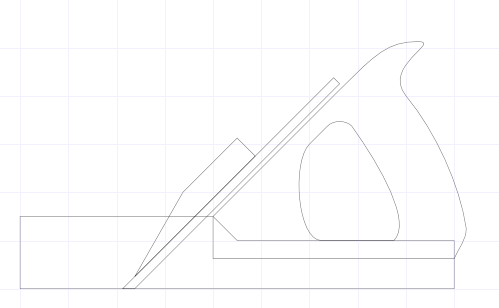
Scrub plane body

I had time to work on the scrub plane today. I already had two milled pieces of wood ready to go, and the drawing was done. So I set out on the somewhat complicated task of cutting the various tapered slots. I made the wedge first. Then I marked out the blade’s bed (at 45 degrees), traced the wedge shape onto both body pieces, and cut out the housing for the blade and wedge:

That’s all fine and good, but you sort of need a path for the shavings to come out. This is the tricky part. You have to maintain a significant portion of the wedge/blade housing, but still open up the area in front of the blade. In addition, you have to open this area to the full width at the mouth. Here’s what I’m working with now:

The area for the shavings is a bit narrow, and the tapered path for the shavings is a rather high angle, but this is probably okay, because the shavings on a scrub plane are not really supposed to be as wide as the mouth anyway.

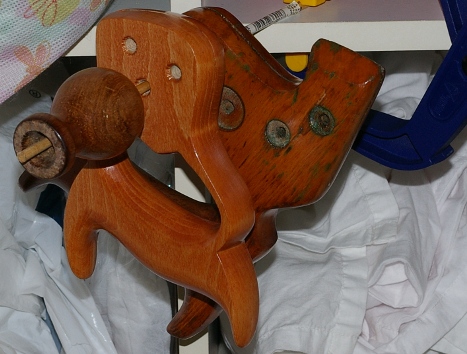
When assembled, the body is supposed to look like this:

With the blade and wedge inserted, it looks like this:

From below, we have this:

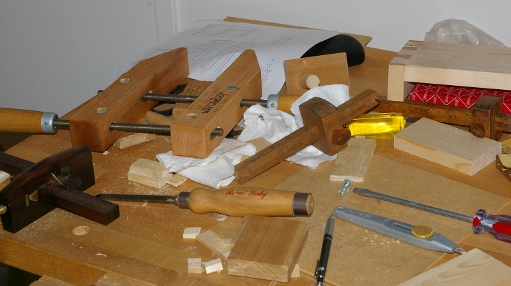
Fine. So I was happy with all of that and decided that it was time to glue up the sides. It was not terribly easy, and looked kind of ridiculous when clamped up:

At least I got it aligned. I’m starting to think that it might have been easier if I had glued it up first, then cut out the various parts. Then again, I wouldn’t have been able to use my saws. Oh well, the price you pay when you don’t have any thick pieces of wood lying around.

Then I sharpened the blade. First time sharpening a cambered blade. Hmm. Well, it could have been worse, I guess.

Surface plate and Stanley 75

Yesterday I went down the peninsula to visit some friends. They’d been asking me for help on a smoothing plane for a while. Specifically, the blade needed sharpening, so I packed up the sandpaper, waterstones, honing guide, and drove down.

Before starting anything, we went to the Woodcraft store. I had been thinking about getting a granite surface plate for a long time. Since I was eager to try out anything that would lessen the pain of flattening the face of a chisel or plane blade, especially the one that was about to be flattened, I bought one. It was at least cheaper than a Hock plane blade.

Well, I’d been hearing stories about people and their surface plates. How they wanted to get married to their surface plates, they loved them so much. How they might have children–you know, that sort of thing. And now I know why. For some reason, it’s a lot easier to flatten stuff on the plate than on glass or diamond stones or whatever. Perhaps it’s because it’s heavier, or maybe there’s more friction? I don’t know for sure, but it works. Using a little water to hold Norton 3x 220-grit paper in place, it took almost no time to get the face of the 2″ blade flat. The blade’s milling helped a lot, too.

I still had the surface plate buzz lingering today, so I decided to see how quickly it would do the job on this little Stanley #75 bullnose rabbet plane:

Very quick, as it turns out. That silly little plane works surprisingly well, too. It’s kind of a pain to adjust at first, but once you get the hang of it, it’s not bad.

Scrub plane design

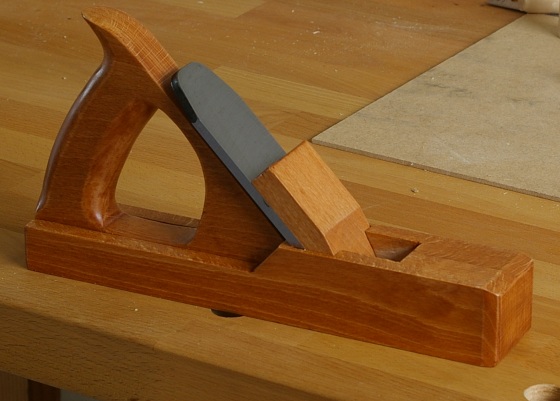
It’s taken forever, but I finally got around to drawing the scrub plane, or at least the side view.

I’m still a little unsure of these dimensions. Most wooden scrub planes have the blade set a little further back. But since I want a tote on this thing, I had to shift a few things around. The basic tote shape comes from the small Lee Valley tote that I got for my low-angle block plane. It’s likely that even if it works out for me, it will not be comfortable for those with larger hands. In any case, the tote is not meant to be grabbed with four fingers; the index finger should go along the side.

I’m not sure what to do about the front. I suppose that it’s possible to put a knob or something on there, but I’m not going to bother with it until I try it out.

Scrub Plane Preparation

It’s been a busy few weeks with practically no time for woodwork. However, there has been a little progress. Today, I finally got around to milling the two faces of the board that will eventually become the scrub plane. As with the mallet, the plane will be made of European beech. What a pain–gave myself a blister doing it, too. The only thing left to do on the board is hit it with a smoothing plane, but that’s easy.

I still need to draw the thing. I think I’m going to go with at least a 10-inch length so that I have enough room for a tote in the back, but I don’t know how tall it should be, nor do I know how far forward the blade will be, and I don’t even know what design I’ll use for the handle.

Other minor activity is that I’ve finally gotten around to finishing the Winchester saw handle that’s been sitting around for at least a half a year. There are lots of nicks in the handle. I used a smoothing plane to knock out the most superficial of those. A washcoat and a coat of stain (a pigment-colored varnish) is now on. I’ll do another coat of that tomorrow, and probably follow up with a some polyurethane. One of these days, someone tell me why it’s so impossible to pour anything out of a paint can. There has got to be a better way.

Another fix for the junkie arrived from Lee Valley today. This shipment included the high carbon blade for the scrub plane. I don’t know why the HCS blade costs $18 and the A2 blade $38. It’s surprisingly heavy.

Also in the package were a small tote and front knob add-on for my low-angle block plane (a sort of silly extragavance, but that plane is really nifty), and two 4″ 2x slim taper handsaw files.

My waterstones had started to dish a little, so I flattened them with my diamond stone. That was delightfully easy.

Milling musing

I still don’t have a scrub plane, so milling this piece of european beech for my future mallet was as time-consuming as you’d expect:

To minimize the pain, I just flattened one side and then scribed the other side for about the maximum thickness so that I wouldn’t have to take off too much stock. I don’t even know how thick it is, just that it’s pretty much uniform. We’ll see why this doesn’t matter in later stages.

I used the jack plane quite a lot more for this one. Working straight across the board and in diagonals took out the cup fairly quickly. The fore plane rounded out the first face, and this side turned out very, very flat.

There was more work to do on the other side because there was still a significant amount of stock to remove, so naturally, it took a long time. In addition, I decided to goof around with one of my smoothing planes again, trying again to improve its tuning. This went fairly well. I managed to tighten the throat a bit and straighten out the frog.

Moreover, I figured out a trick on how to straighten the frog: if the sides are square, you can use a double square. Put the stock on the frog bed (where it meets the blade), and extend the rule out over the side. If the frog is square, the rule can sit flush with the side of the plane, because those two surfaces are, in theory, supposed to be orthogonal. I suppose that a photo would be handy here, but I’m too lazy right now to show it.

The downside of all of this messing around with the smoothing plane is that in my excitement, I took off a little extra from one of the edges, making the second side “not quite flat.” In the grand scheme of this project, it does not matter. In fact, it might be a good thing.

The only thing that does matter is that the next thing I mill down had better be for the body of a scrub plane.

Milling, Part 5

At this point, I’d milled my board to width and depth; the only thing remaining was cutting it to length. My goal was two one-foot (roughly) lengths.

This meant using a crosscut saw, preferably a backsaw, which meant that the task fell to the old Jackson saw I’d been playing with. I wasn’t terribly happy with the initial sharpening job I did on it. The saw kept wandering around in the cut. so yesterday, I decided to try again. I jointed, shaped, and set the teeth, then went about to pointing the teeth.

I screwed up, and the teeth ended up looking ridiculous. The saw didn’t exactly cut so well, either. So I jointed, shaped, and set again, and then I screwed up the pointing again. So I jointed, shaped a little, then went to bed.

Not to be deterred, I woke up this morning (“full” of energy), and decided to try a few different things. First, I used less set on the teeth. Then I set about pointing with a lower fleam angle (something like 10-15 degrees). Finally, I decided to ignore the rake angle guide when pointing, rather relying more on sight and feel.

The saw certainly looked a lot better when I finished. And it cut better–it did not wander around now. So I was ready to put it to use. Here’s the end product after shooting the end grain with my low-angle block plane:

Yay. I’m done with milling. Plus, I got to put the Veritas plane to a torture test of sorts.

I’m still not thrilled with the backsaw. It cuts smoothly and relatively quickly now, and it doesn’t wander, but I can’t help but thinking that it could produce a finer cut. The question, though, is if I’m barking up the wrong tree here. That saw has just 10 teeth per inch, which is fairly coarse for a crosscut saw anyway. This thing may be better off as a ripsaw for tenon cheeks and stuff like that. I don’t think I want to retooth it, because that will wear down even more of the saw, and there isn’t much blade left to begin with.

Whatever. I’m ready to try making a mortise-and-tenon joint now.

Milling, Part 4

In the last milling episode, my board was now flat on three sides. I needed to rip it to its final width of 2.5 inches. First, I scribed a line around the cut with my marking gauge, then pulled out my now-functional ripsaw. I took the cut a little slowly, not really knowing what to expect. The saw did its job perfectly, guiding itself with the kerf and never wandering:

To get the final surface on the edge, I had two choices with my jointer plane: use a shooting board or try it freehand. Since I don’t have a shooting board, and I didn’t want to cobble together some lame setup again, I opted for the freehand method. It was a lot easier than I thought it would be.

That little Lee Valley double square is really handy for checking the edge.

There’s just one thing left to do: saw the end square to final length and plane it smooth. But for the rest of today, I’m going to clean and wax a few tools that seriously need it (like that jointer plane, ugh).

Milling, Part 3

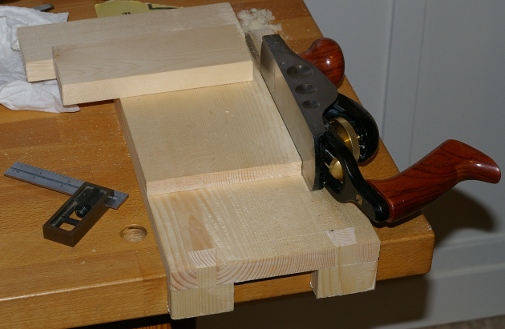
At this beginning stage, I do not have much material (MDF, ply, etc) for making jigs and fixtures such as shooting boards. But I decided that I want to use a shooting board-like thing for squaring up one of the edges, so I improvised something out of a bunch of pieces of hardboard on my bench:

At the near end that you can’t see, my Veritas® “Wonder Dog®” is holding the edge in place. It worked fine, though I can see where a hold-down or holdfast would be better. I am not interested in forking over the cash for one of those right now.

Though I seriously need to get the rust off that #7 jointer frankenplane, it did the job fine. My square says that it’s a square edge. Oh, goodie gumdrops.

Next, I need to rip the board to width, and that means that I need to get one of my saws into ripsaw shape. Tomorrow, perhaps.

Anyone notice that Lee Valley recently announced their new Veritas plow plane? Only costs about a million dollars, as you probably guessed, but it does look kind of slick.

Milling, Part 2

Against my better judgement, I decided to mill the second face tonight. First, I used a marking gauge to scribe the target thickness into the edge of the board, then threw it rough-side-up on the bench:

Yeah. That’s about a quarter-inch that I had to knock off the board. That should sound like a pain. And it was. Sort of. It took a long time because I used only the #6, but I finally arrived at the goal:

This face turned out to be a little bit flatter than the first one. Practice, I guess. Or desperation. Whatever. It’s not as “smooth” as the first face, but that’s only because I decided that I didn’t want to get really anal with this, especially considering that a smoothing plane is going to hit it at some point.

If I have to do much more of this, I am seriously going to look into getting a scrub plane. The sheer number of shavings that I ended up with was ridiculous.

Next up, I’ll need to shoot one edge flat and square, rip to width, and plane the other edge. I probably need to improvise a shooting board for this.

Milling, Part 1

My goal for yesterday was to set up my sawhorses and saw off a piece of poplar for milling four-square. I was going to do the sawing outside, because it’s kind of messy. But by the time I got my act together, it was getting late, so I just did it in the kitchen.

At first, I tried using one my larger untuned handsaws, figuring that it “seemed sharp enough” for such an unimportant job. Ho, ho, wrong idea. After having it bind a few times and not really cut much, I decided to go back to my Jackson backsaw–not the ideal tool for the task, and not even ideally sharpened (remember, it was my first saw sharpening practice). But much, much better. So I am going to need to try to focus on sharpening a few more saws.

Then I cleaned up, watched “Cops,” and went to bed.

Today, I set about the task of flattening one face of the board. I selected my half-tuned Stanley #6 to do the rough work, did a somewhat slapdash job of sharpening the blade, then set out to work:

This image is after about 15 passes or so; there’s still a lot of fuzz in the front of the board and at the rear, and it’s still cupped. By this point, though, it was apparent that this fore plane was doing a much better job than I had anticipated. My original plan was to move to a jack plane as soon as the board was halfway flat. However, the surface left by the #6 is pretty nice and probably ready for a smoothing plane. I should have probably flattened and waxed the plane’s sole, I guess… this would have made it a lot less work.

After working up to full-length shavings, I used the plane and the ruler in the background as winding sticks to determine when the top was flat:

It’s actually reasonably flat. Not perfect, but close enough. There was now a huge pile of shavings on the bench.

I hadn’t expected the board to be this flat on the first try. I also hadn’t expected the board to be significantly thicker than one inch (it was). Because I have a goal of 3/4″ thickness, this is the part where I think that a scrub plane would be really handy right now. Alas, I do not have one. Perhaps I’ll use one of my jack planes set for thick shavings.

The question is if I’ll do this today or not. It’s still early, but I am dedicated to taking an agonizingly long time to learn how to do this stuff. Decisions, decisions.