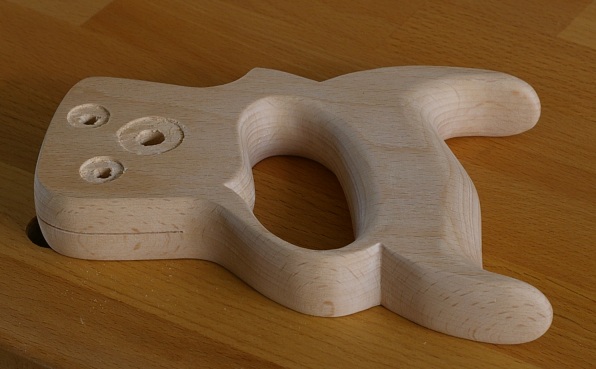
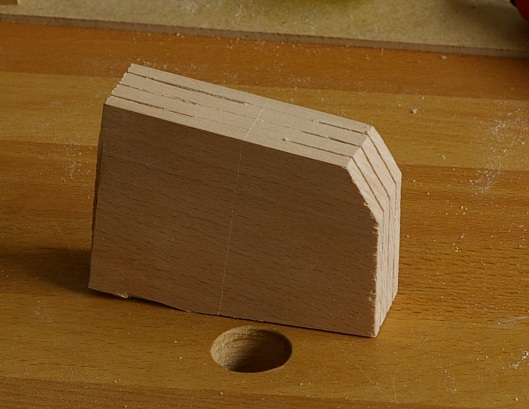
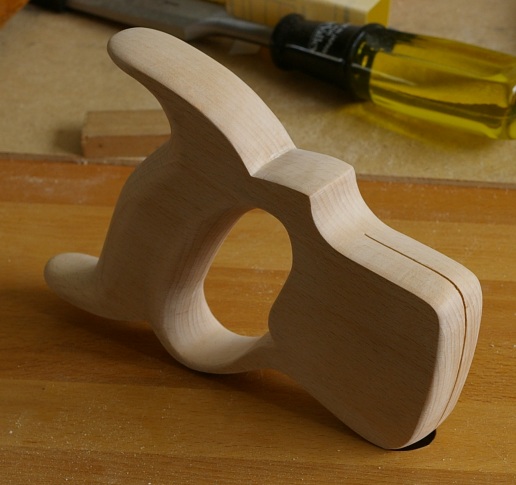
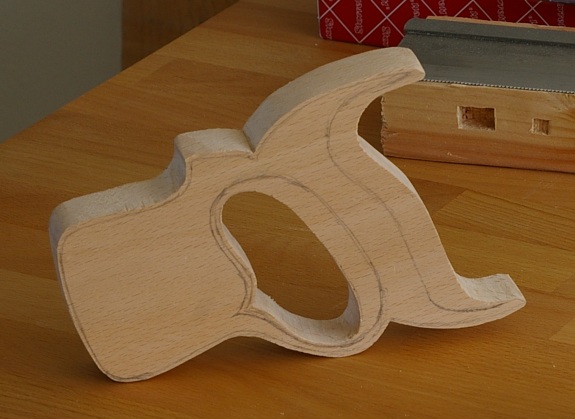
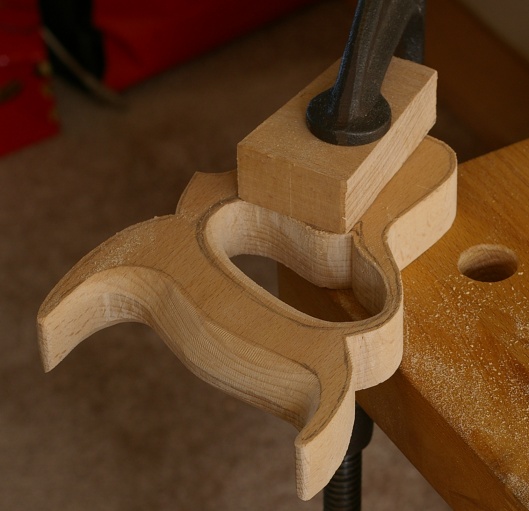
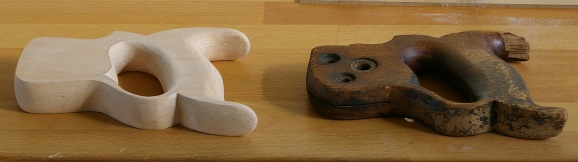
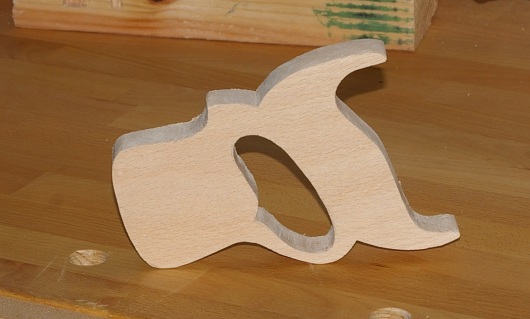
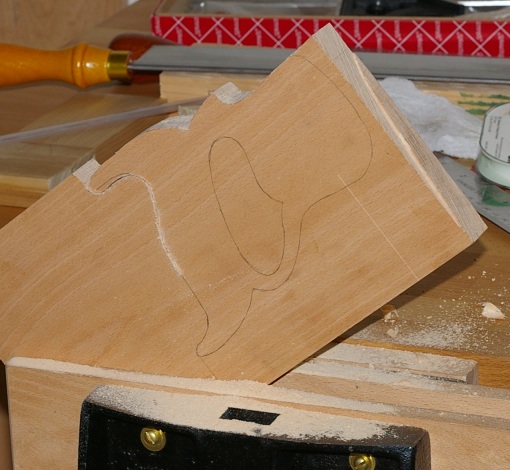
Saw handle: Cut out cleaned

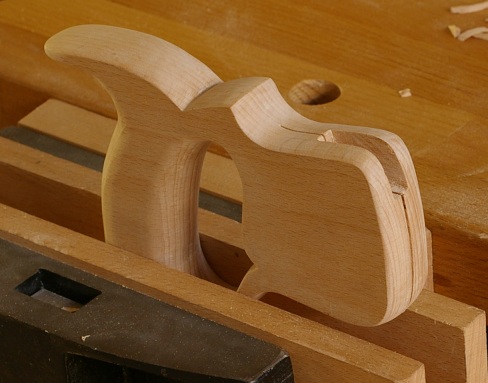
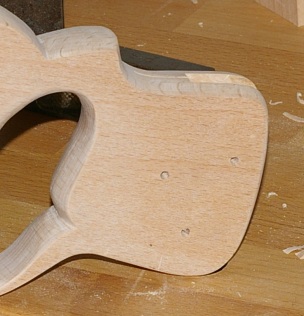
Instead of starting to shape tonight, I decided to clean up the rough saw marks made by cutting out the handle.

That’ll be it for tonight. Somehow I came up lacking in the energy department.

There was some question about “purity” somewhere or other, or in other words, “would I have used a scrollsaw or bandsaw to make this if I had one?” Well, yeah, probably. Remember that Disston wasn’t shy about using machinery to make all of those beautiful early 1900s saws. They weren’t stupid, and they sure had room for some bandsaws.

Saw handle: Cutting

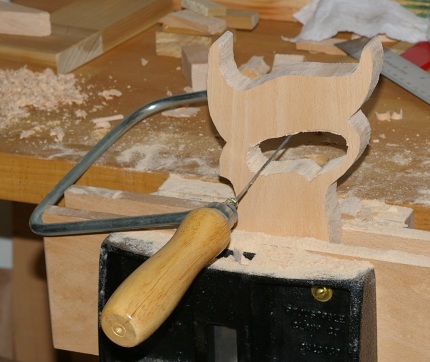
The worst part of making handles seems to be cutting out the handle. I’m still using a coping saw for this. I should probably wax the blade. In any case, beech does not cooperate much.

It didn’t take terribly long. The grip is maybe 1/32nd thinner than the original, which is probably okay. I’m not going to bother to even it up tonight. I’ll do that when I go to shape the handle.

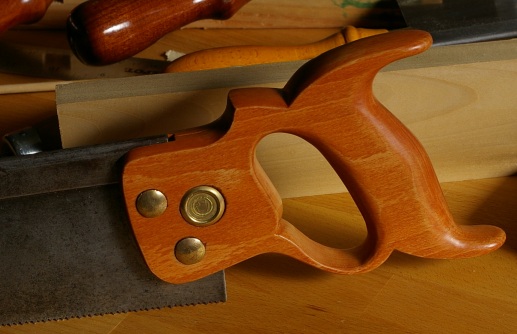
Saw handle for Jackson backsaw

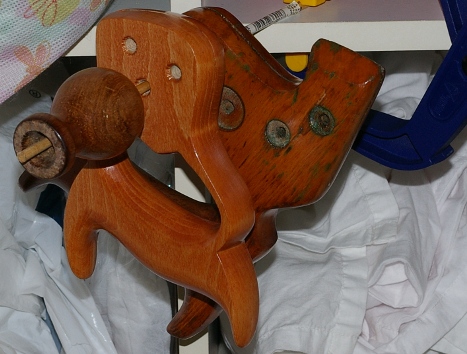
The handle on my old beat-up Jackson backsaw looks really sad and has a lot of nasty rot and gunk in it. In preparation for the handles on my other backsaws, I thought it might be a good idea to start with the old one, just so I can continue to mess around with a saw that isn’t worth very much.

I finally got my stupid scanner working and scanned the old handle. Then I used Inkscape to trace the outline, and finally, today, I cleaned it up a little. I got this thing:

This seems reasonable, and the dimensions also appear to be correct. I didn’t try to make it pretty or add extra flair. The “holes” are almost certainly inaccurate, but I don’t care, since I’ll be transferring them from the blade and not the drawing.

It’s a somewhat “urgent” project now. I put new teeth on another one of those cheap Craftsman dovetail saws this weekend, so I have the “urge” to put a real handle on the ones I have. This time I went for 14tpi rip, and I used a worn 5″ x-slim taper to cut the initial teeth. That went a lot faster this time.

The saw works perfectly… as a dovetail saw, that is. This is or is not unfortunate, depending on how you look at it. I wasn’t intending to make a saw that cut as well as this one, I just wanted something that was faster than my current 20tpi dovetail saw. This cuts so well that I might just try it for stuff that I used the dovetail saw on before.

So I’ll probably be getting yet another one of those cheapie saws. This time, I’ll file it to something like 10 or 11tpi rip. That ought to do what I want it to. Except that maybe I wanted to make a panel saw? Eh, I guess it doesn’t hurt to have a few.

[Update: The template is now available on the Plans and Guides page.]

Winchester Saw: Finished

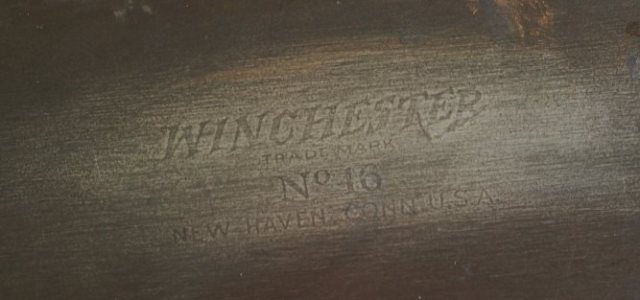
My Winchester No. 16 handsaw has been sitting around waiting for me to do something to it since time began. I’ve had this saw for nearly five years. When I finally decided to do something about it, it was back in March, when I discovered that it was a Winchester:


I didn’t know what to do with it at that point. It’s a mildly rare saw, so one option was to try to sell it for something useful, for example, a pile of Disston D-8s. But the handle was in crap condition, and it had the less-snazzy “Warranted Superior” medallion, so I decided to restore it and keep it as a user. I don’t know when I decided to do that, but it was a long time ago, and as such, I’ve had the blade sitting around, derusted and waxed, waiting for sharpening. I took the handle off, and procrastinated on the refinishing.

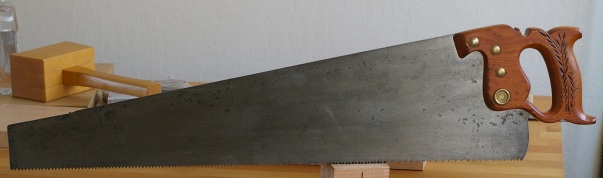
About three weeks ago, I decided to do something about it. I finished today:


The saw was filed to 6TPI. That’s pretty coarse for a crosscut saw, so I was originally going to make this a ripsaw to replace my beat-up D-7. However, the handle has that funny notch on the top that would make ripping uncomfortable with two hands, so I figured decided that this would, in fact, remain a crosscut saw. The rake angle is 15 degrees, with the fleam angle at 20 degrees. I had initially filed a 20-degree rake angle, but I screwed up pointing it (of course), so on my second try, I decided that since it was so coarse that I should make it a little more aggressive. It was probably a good idea; it does saw very efficiently. The cut is fairly clean for 6TPI.

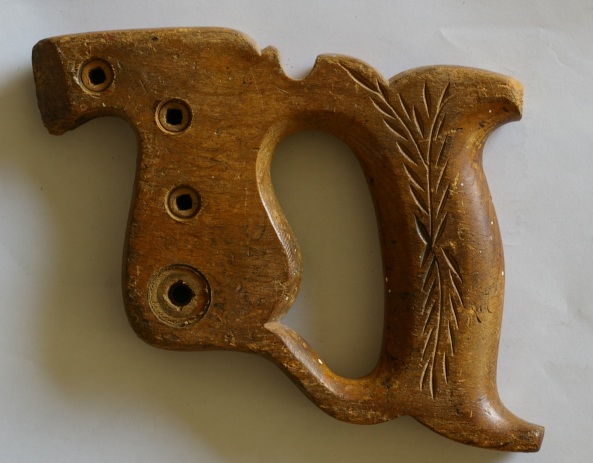
I spent about a million years refinishing the handle. It was dented, nicked, and beat up. This photo also shows how the top horn was mangled:


The first thing I did (several months ago) was strip the original finish. At the same time, I cleaned the sawnuts:


And then it sat. And sat. And sat, until about three weeks ago. Even after stripping the original finish, it was still really uneven, so I sanded around the curved parts. For the flat parts, I just skimmed it with a smoothing plane. At this time, I also learned what the wood in the handle was for the first time–American Beech (fagus grandfolia). OK, well, that’s not a big surprise.

Then there were decisions. Should I stain it? With what? I finally settled on few thin coats of a “Colonial Maple” pigment stain. I used a washcoat beforehand. Though it would result in accented nicks and dents, it would even out the flat parts, and who’s going to try to hide the fact that this saw hasn’t been used, anyway?

Finally, I decided to use the same flat-sheen polyurethane that I used on the mallet as a protective top layer. I went from a thin coat to thicker coats, then back down to thin coats for the final one. Several coats were necessary, because the varnish would run down the surfaces that were vertical, depending on the way you held the handle. I did the first coats with the handle held upright, then the later ones held flat. A close-up of the finished handle:


I used a progression of 320 grit sandpaper, #0000 steel wool, 1500 grit sandpaper, and rottenstone, all lubricated with mineral oil, to rub out the finish. There’s still a scratch here and there from the coarse-grit paper (because polyurethane is tough), but overall, it looks nice, and it’s very smooth to the touch.

Millers Falls flange wheel mystique

I’d mentioned earlier in an earlier entry that there has been some hubbub about the design of the Millers Falls #2 drill, namely that some guy named George Langford says that the later dual pinion design is inferior to the flange roller. I eventually snagged a really beat-up #2 for cheap on ebay. It’s hard to date this one precisely, but it’s probably at least 105 years old; it is a type H, I, or J, which includes a chuck patented in 1890. It’s hard to say exactly what type it is because the side handle is missing and the main handle is a replacement:

This is, of course, beside the point. It’s a flange roller model, and the real question I wanted to answer was, “does it really turn that smoothly?” Why I cared, I don’t really know.

Well, “out of the box,” it didn’t. In fact, it was a lot worse than my dual-pinion #2, but I didn’t take much stock of that. I suspected that it needed some cleaning and lube, just as my dual-pinion did (and as one of my #5s did).

As you might be able to tell from yesterday’s entry, that job sucked. Every tooth gap on the main gear and pinion had caked-on grease inside. I picked it out with the closest pick-like thing at hand, which happened to be a putty knife (a real precision instrument). Then I wiped away the residual crap with some WD-40 and a toothbrush, and called it a night.

Then today, upon arriving home from work, I was faced with a pile of drill parts on my dinner table, so my executive decision was that putting it back together was better than eating it. So I cleaned off the flange roller, applied a little bit of oil to the proper places (basically, any metal that rubs against any other metal, except for the gears, because they’ll just collect grease again).

The result?

Okay, that is one smooth drill. It’s really hard to describe, but it’s significantly smoother and easier to turn than anything else I have, and anything else that I’ve ever tried, and that’s saying a lot, because one of my #5s is very, very smooth. Maybe there really is something to this flange wheel mystique after all.

First complete saw

Last week, I finally finished off that Jackson backsaw that I’d been working on since before the dawn of history. Here’s what it looks like when all was said and done:

Skipping back a few entries, this is what it looked like before I did any work:

As you may recall from the last episode, I messed up badly and had to reshape the teeth before I got to the final stage of pointing (sharpening/filing the fleam). But finally I got to print out my tricky-dicky PostScript fleam guide and use it properly. Here’s how it looks in use:

All you do is align the file over each line and take a few strokes. This picture was shot after the first half of the teeth were done, so you can see how every other tooth is a little shorter. It evened out very nicely, just as it was supposed to, and when viewed end-on, the “valley” that you’re supposed to see between a crosscut saw’s teeth was there. Fantastic.

The tip of this saw isn’t in good shape. There’s a kink in it, and the teeth are especially uneven there. Because it’s only about an inch and a half of steel, I’m considering taking the moderately drastic measure of hacking off the tip. I likely already would have, except that I don’t have a machinist’s vise yet.

I didn’t do anything to the handle of this saw, either. Unfortunately, it’s shot; it’s soft almost all the way through, making it hard for the sawnuts to get a grip. The sawnuts are also in bad shape. So I just put it back together so that it wouldn’t be too loose. There’s no point in fussing with it any more; if I want to improve the handle, I’ll need to make a new one. (This is not a bad idea, because I like the shape of the handle and have this fantasy of eventually making my own saws.)

Well, so much for the saw’s looks. A more important question is, “How does it cut?” I’m happy to report that it’s great. Due to its somewhat aggressive rake angle and the relatively low number of teeth per inch, there is moderate tearout, but it saws quickly and with very little effort.

For some reason, I don’t particularly expect to use this saw much. It should be fine for cutting smaller boards down to size in a miter box, and for cutting down the shoulders of tenons, but it’s too small for large boards, and because it’s a crosscut saw, it’s useless for sawing down the cheeks or anything else that’s a rip operation. That’s fine, though. My next two saw projects really ought to be full rip and crosscut handsaws.

I’m a little relieved that my two candidates for those two saws are in much, much better shape than this thing when it started out…

One step forward, one step back

I got all “high-tech” on the problem of pointing the teeth in my Jackson backsaw, thinking that I could maybe do something a little differently because I know the PostScript programming language. So I wrote a program to image a fleam angle guide, and spent last night getting my infuriating printer to work.

I couldn’t resist the urge to tweak the program a little while I was at work, so I was really excited to come home, print out the guide and try it out.

Unfortunately, I was in full bonehead mode. I put the guide on backwards and promptly screwed up the shape of my teeth. So I had to reshape and reset the teeth. Not that this was a bad thing; the teeth near the front of the saw were a little messed up. However, the file I was using is now history; I’ll need to get another one or two tomorrow.

I’d mentioned earlier that setting the sawteeth was a royal pain in the ass. Perhaps this was a “happy accident” today, because setting the teeth went a lot faster today due to this setup:

The first thing that helped here is that I printed out my pointing guide with a fleam angle of zero degrees and taped it to the saw, effectively making it a setting guide. This helped out a lot. No more squinting, trying to figure out if I was on the right tooth; just point at the next line, squeeze, and move on.

The other thing (and this is a big duh for me) is that I put the damn thing in the saw vise this time. Why I didn’t earlier is beyond me.

First sawtooth shaping

I knew that I would need to shape the teeth of some of my saws sooner or later in order to sharpen them properly. I decided to start with the Jackson backsaw that I’d de-rusted earlier, again figuring that I’d only be out $1.99 if I messed it up.

The teeth were at 11 points per inch, but very badly shaped in some parts, especially the tip. So I started with jointing. I don’t have a saw jointer, but you can just use a mill file without a handle. Maybe I ought to buy or make a jointer, though; it’s hard to get a good grip.

I decided to set the rake angle at around 20 degrees, a moderately aggressive cut for a crosscut saw. To make a rake guide, I cut out a chunk of yellow-poplar and drilled a hole in the side (as recommended by most saw-sharpening guides).

It turned out surprisingly well, especially considering that this was my first attempt. The teeth are reasonably uniform, and it certainly looks much better than it used to. It seems that it is important to take only a few strokes at a time with the file, going over the teeth several times until they start to look alike. However, due to the poor initial shape, I did remove a significant amount of steel to get to this stage.

Next up for this saw is setting and creating the fleam angle. Hopefully, I’ll have gotten the handle in decent shape at that point, so I can test it out right away.