Rip Panel Saw: Sawplate Modifications, Taper Grinding Musings

Sometimes, you gotta learn the hard way.

I started work on the sawplate by cutting off a bit of the tip so that the hang hole was off and there was a reasonable depth to the blade at the tip. So far, so good–no trouble encountered there.

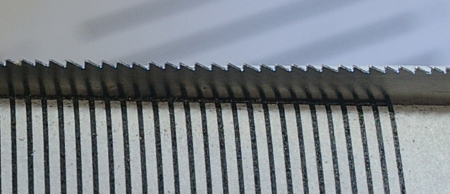
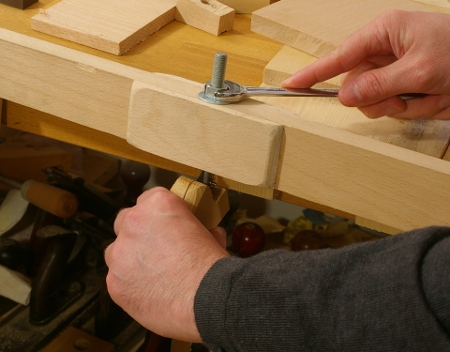
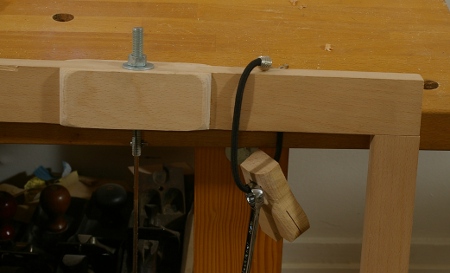
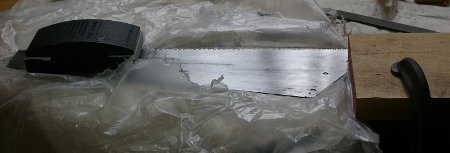
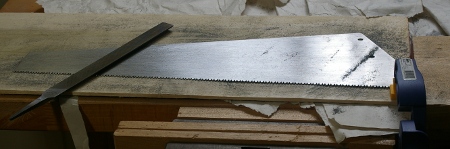
Then I removed the lacquer from the blade with this clamping arrangement and Norton 3X sandpaper:

That, too, worked pretty well, and to my surprise, it removed .001″ of the thickness of the blade. That got me thinking that, hey, maybe I could remove some of the steel with this sandpaper, too. Maybe I’d even be able to taper it!
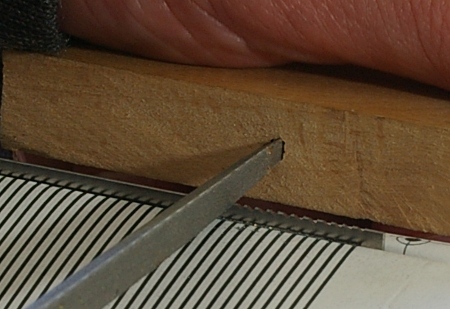
Well, that turned out to be an idiotic idea. Spring steel is still pretty hard, m’kay? After wasting who knows-how-long to remove maybe .0005″, I decided that maybe I’d try drawfiling it:

That sort of worked. After expending a ridiculous amount of effort, I’d knocked the plate down to about .032″ (from .035″ originally), and I got the tip of the top tapered down to about .029″ (maybe). I decided to call it finished.

Please don’t try this yourself. It was an incredibly stupid idea, and I’m never going to do it again. If you want a nice blade, I suggest this approach:

  1. Start with the blade thickness that you want in the first place.
  2. Use something like a belt sander with Norton 3X belts if you want to taper grind it. (And remember to use proper safety equipment–a respirator mask, safety glasses, gloves, and something that will hold that blade in place with no chance of letting go.) Not that I’ve tried this, but it’s hard to imagine any way that this would be worse than what I did.

Speaking of taper grinding, I discovered something about it when working on this project. There is a fair amount of smoke-and-mirror action going on with some of these old taper-ground blades. Most full-size handsaws seem to go from a full thickness of about .040″ to around 0.030″ along most of the significantly-tapered tapered part of the top, then it drops down to about 0.025″ at the very tip at the top (maybe the last half-inch). So that’s about 25% thinner along most of the top and I can see where that could be helpful in use. But the teeny bit at the very end? Meh. You hardly ever even have that part in the kerf, anyway.

My Pax saw has similar taper grinding as on the old saws except at the very tip. It appears much thicker than the old saws, but measuring reveals that it’s about the same. What’s going on here?

The original saw that I’m copying has less significant taper-grinding along most of the top–its cutting side is about .031″ and it’s ground to about .028″ along the top. That’s about a roughly 10% difference. However, it looks a lot thinner up there, and after a long time, it dawned on me that they’ve rounded off the top of the saw a little to make it look more elegant. It was the same thing with the older saws, and that’s why the Pax doesn’t look like it’s been taper-ground as well, even though it has.

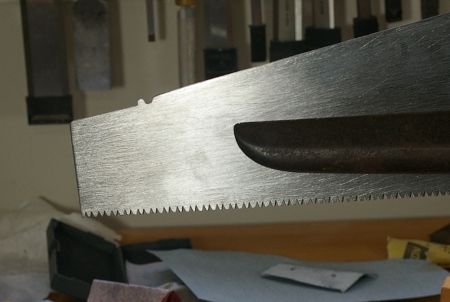
At this point, I was really starting to lose my mind, so I did the same rounding operation on the top of my new sawplate, and guess what? It now looks like it’s been “seriously” taper-ground. Continuing the absurd voodoo practice, I filed a nib onto the thing:

Now I’m almost ready to form and sharpen the teeth. I was originally going to file off all of the teeth and start new ones. However, it seems that the original teeth on this saw were set at 8TPI, which happens to be about what I want on this thing (it also matches the original), so maybe I don’t have to go the whole way.

The handle varnishing is almost done, too.

Rip Panel Saw: Choosing a Sawplate

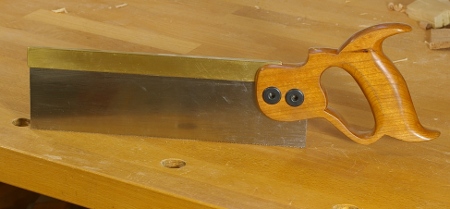
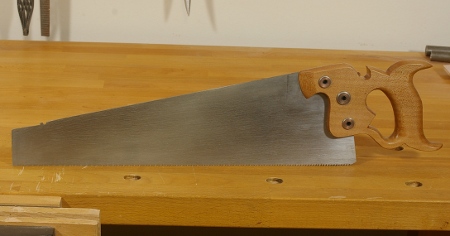
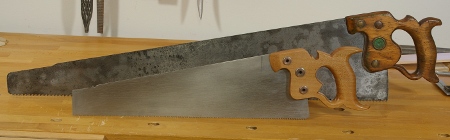
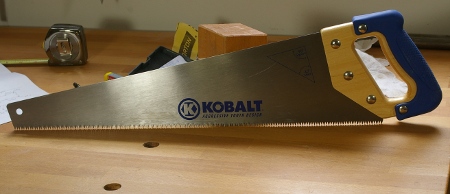
While the handle is in the varnishing stage, I’ve been worrying about how to approach the sawplate for the new saw. Being the cheapskate that I am, I have been considering using the plate from this thing that I picked up for a song and a dance some time ago:

The basic shape is right, but of course, I’d cut the tip off to make it look halfway normal, mill off the teeth, and cut new ones, and do whatever else is necessary to get it fit on the handle.

The trick to all of this is the thickness of the plate. It’s kind of a tricky business, because all of the old saws were taper-ground, and you won’t find a cheap saw these days that is. So I’d be giving that up, but I don’t have any old saws that I can cannibalize anyway.

Furthermore, until now, I really didn’t know the thicknesses of any of the plates that I was working with; I was only able to sort of guess by looking at them. Well, that all changed when I finally got off my butt and bought a micrometer. Why I didn’t get one before, I’ll never know. It’s really taken a lot of the guesswork out of a lot of stuff.

I’d been wondering about this because I’ve got saws that turned out in certain unexpected ways due to this, and I really didn’t know about it before. For example, my crosscut carcase saw works wonderfully, but a rip version of it didn’t turn out the way I wanted it to. The plate on those two saws is .0263″, but you’d really want something more like the 0.020″ thickness found on most dovetail saws.

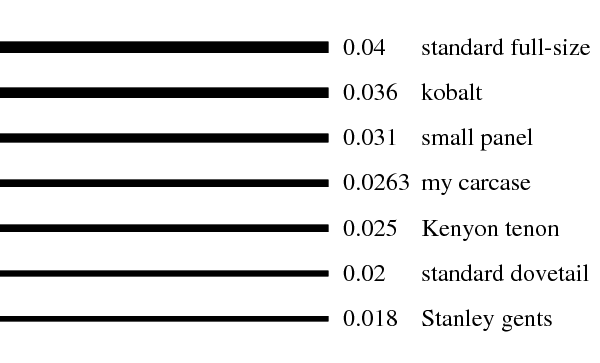
What’s .0063″ of difference? Well, one way to think about it is that it’s 31.5% thicker, which is pretty significant. In theory, you’re cutting 31.5% more wood, and so it’s 31.5% more work to do it. (This does not hold for a crosscut saw, where you are slicing fibers out instead of scooping shavings.) You can also look at it visually; take a look at the following image that I just cobbled together as a PostScript program:

The difference between .020 and .0263 looks pretty striking here. These thicknesses are at the cutting edge. I have the measurements for the tops of the saws that are taper ground, but I’m going to set that aside for the moment.

As you might have noticed, I put labels on this image. Of course, after I got my micrometer, I obsessively measured all of my saws. I don’t have a Kenyon saw, but it’s listed here as a representative for a big tenon saw (the Wenzloff versions have .025″ plates).

There are some surprises, such as that Stanley dovetail saw with the gents handle. This is a relatively new one that I picked out of a basement. I never bothered with it because I already had the Crown equivalent (.0205″), but you can see that it’s quite thin! This is the saw featured in Korn’s book, and it should be pretty obvious that if you’re willing to learn how to sharpen it, it will give you experience with a thinner plate and should work just fine. It’s no wonder he has no trouble recommending it.

So getting back to the question at hand, is the lovely “Kobalt” plate going to work? I think I’m going to give it a shot. It’s about 16% thicker on its cutting edge than the original that I’m working with, but that doesn’t seem that bad (and some of this thickness may be lacquer). The thickness of the original is a little unusual anyway; full-size saws are about 33% thicker. The only blade I have that’s close is my frame saw blade (0.029″), and, er, that’s not gonna work.

Then there’s the matter of taper-grinding. Should I try this? I’ve got sort of an idea of how I can do it without a power tool (although if I were sane, I’d ask to use someone’s belt sander). Would that warp the plate? Hmm.

Rip Panel Saw: Handle Shaping

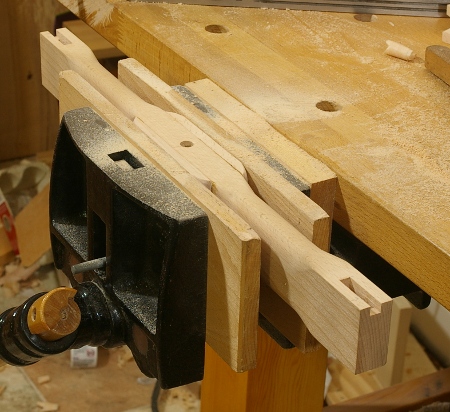
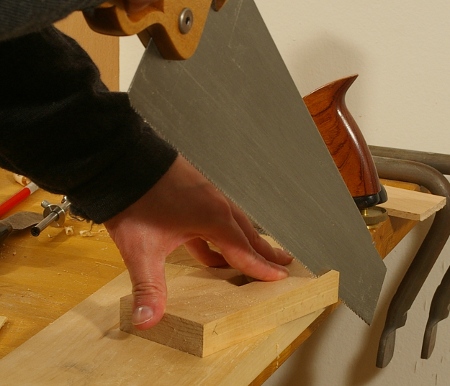
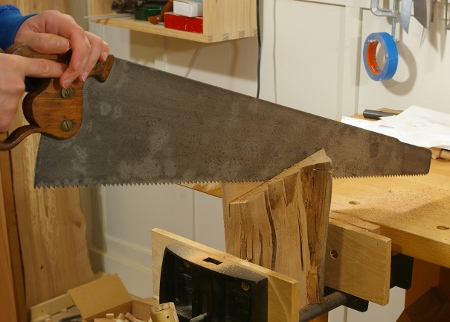
Available time to work on this saw comes and goes, but it’s getting somewhere. After coming up with the template, I grabbed the piece of madrone that I’d worked on before (and made the nightstand drawer pull from) and thought that there might be enough of a solid section to make this handle. I started by ripping down the sides (you can’t split madrone as you can oak, because it does not split terribly straight). I came up with the following ridiculous-looking, yet surprisingly effective workholding arrangement:

I thought that it might be a pain to saw, but it wasn’t that bad. I also have a newfound respect for my front vise. Before long, I had a little board milled.

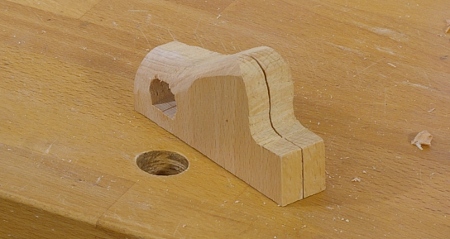
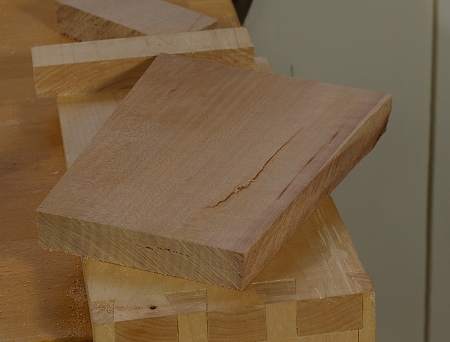
The big question still remained about the checks. I suspected that I would be able to position the handle cutout where the cracks would not extend, so I traced out the pattern:

Yes, this would be unaffected by the check on the top of this photo, but I didn’t know how far in the one at the right end extended. When it was all said and done, a small amount does remain, but its location is inconsequential (details of that might be in a later post).

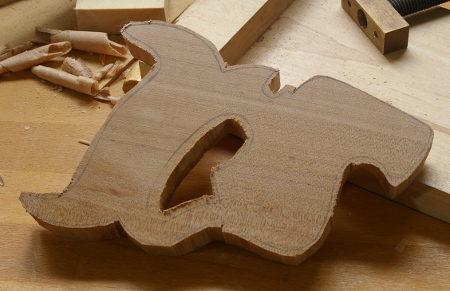
I cut out the rough template with the coping saw:

As I was doing this, I started to suspect that the shaping process would be somewhat more difficult than my previous handles. There was something about this wood that just felt different.

I made quick work of getting down to the lines on the outside with my saw rasp and sawmaker’s rasp, but the inside was a little trickier because there wasn’t much space to work. I started to wish that I had an inchannel gouge, and after a minute or so, I realized that I did have one, that Taiwanese one I’d bought during the holidays.

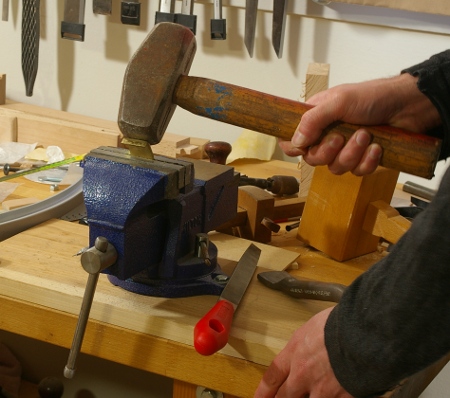
I don’t have a proper mallet for it, so I just banged at it with a marginally not-uncomfortable chunk of the madrone cutoff, and this got the job done (though I think I want a proper mallet):

It turns out that this is a really good gouge! (The ones with the red at the ends are supposed to be the better ones.) After all of this chopping, there were no nicks and it seemed just as sharp as ever. I’ll have to pick up a few more of those on my next trip.

Then it was off to shaping. That, as I suspected, was kind of a pain. Madrone cuts easily enough but its sawdust is really fine and clogs everything quickly.  I ended up using a lot of 60-grit Norton 3X sandpaper to fine-tune the shape because that stuff doesn’t clog so easily. I used a 1/4″ chisel for a lot of the nooks and crannies and imagine that some outchannel gouges would have been handy. But I did eventually get it done, and then cut the kerf for the blade using my trusty gents saw:

I also tapered the front with this saw, but made some modifications to the original. Here’s the new handle next to the original:

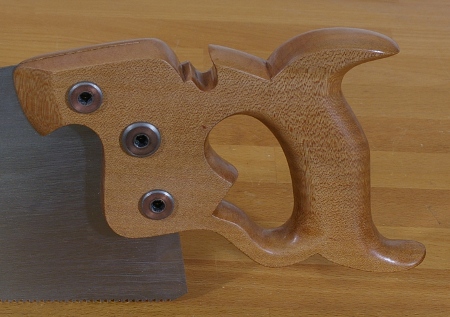
The new one is tilted slightly counterclockwise to the original in this shot, and there are some perspective issues, but you can see some subtle differences, some intentional, some not quite so. The bottom is a little thicker and the cheek has a little bit more surface area. The front is tapered a little differently. The original’s tapering was uneven, so I decided that I would smooth it out a little on mine. The unintentional change is how the back of the “lamb’s tongue” isn’t as deep as on the original. I can’t figure out how this happened, but I’m not going to bother changing it. (If I didn’t like the way that it looked, I’d change it, but I do like it.)

So now, I suppose I should put some holes in there for the screws and varnish the thing. And I happen to be already varnishing the nightstand at the moment–how convenient.

Rip Panel Saw: Handle Template

I’ve got the nightstand drawer in the clamps, put the first coat of varnish on the frame, and sized up the top. Now with just varnishing left on that project, I have been given license to do whatever I want for the next two months while I do the finishing (and wait for the varnish to dry) on that project.

Aw yeah. I’m gonna make me some more tools.

The list includes three saws. One of these is a little panel saw filed rip that I’ve found myself wanting several times in the past. There’s another reason for this–I’ve got an old Disston panel saw, probably a No. 7, that I really like, but won’t use because the handle is loose (due to a crack), the blade’s slightly broken at the end, and it’s kind of rusty. The handle on this thing feels incredibly comfortable in my hand and I’ve always wanted to make one.

I had a little time today to work on the template for the handle. I dug out an old PostScript program I wrote that draws a grid, barbarically converted it from metric to imperial units, and printed it out. Then I placed it on a wall next to a shelf, put the saw on a shelf, and took a photo (dumb note: this is one of the very few on this site where I used a flash):

Hey, let’s look at that medallion really quick:

The Disstonian Institute says that this is from around 1874-1875.

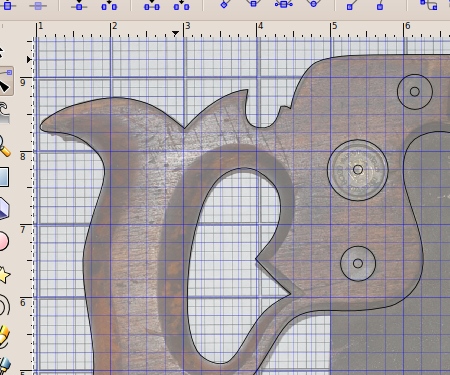
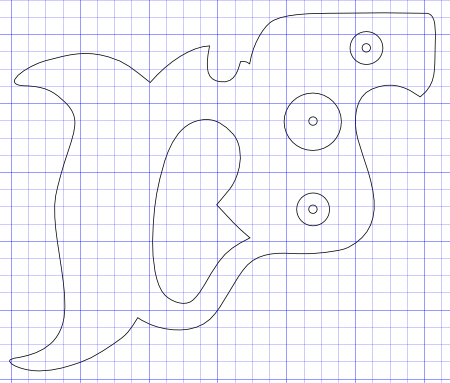
Getting back to the task at hand, I loaded a cropped version of that photo into Inkscape, scaled it so that the grid matched the scale of the page, then made that layer transparent and laid out the pattern on top as vector graphics:

This was a lot easier than I remembered it being in the past. It only took about 20 minutes to get it set.

Normally, I would try to simplify old-fashioned lines on a handle because I like to have a somewhat more contemporary design (for example, ease out that angle on the inside), but I like this saw so much that I’m going to try to clone it as faithfully as possible. That’s not going to stop me from using my usual furniture connectors as the hardware, though.

With the lines set, I printed out the template:

Now I have to cut it out and trace it onto the piece of wood that I’ll use for the handle. The trick is that I don’t yet actually have a piece of wood. Okay, gotta work on that.

[Update: This template is now available on the Plans and Guides page.]

Taiwan: Final Tool Survey

Here’s an inchannel gouge I got in Taipei. This is how all of the “local” carving tools there I saw were designed:

taiwanese_gouge

It’s fairly long, maybe about 9″ or so. But that’s not the first thing you notice about it–the lack of a handle is. They typically aren’t used without mallets.
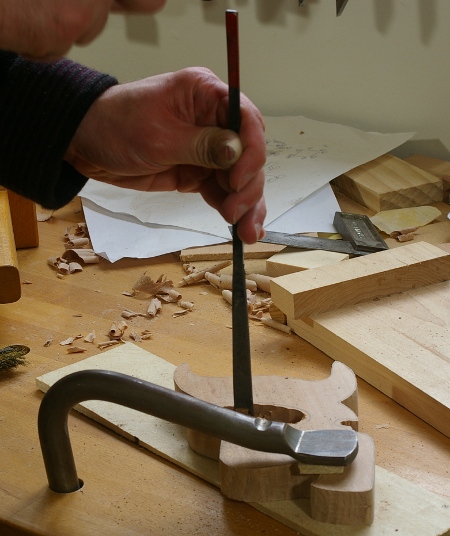
These things are struck with a long, rectangular mallet made of a single piece of wood. They are somewhere around 2x2x9″, with one end rounded so that it’s comfortable. Due to the small hard area that they hit, the mallets quickly form concavities on their faces. So soon after you start using a new mallet, it tends not to slip.

Although it looks cheap, this gouge was not particularly cheap. The red at the end means that it’s made with “quality steel,” and I think the cost was about $8. I’ve tried it out and it works fine, but I think I’d prefer to make an appropriate mallet before doing too much with it.

The plane below is a little block-esque plane made by “Hsieh Hsing:”

tw_block_1

This one actually came with packaging, which advertised it as “Japanese-style,” despite the fact that it’s no different than any Taiwanese plane I’ve seen. It’s short (maybe about 4″ long), and has a thick, quality blade that was very easy to flatten. Its throat is rather wide open, which lends it to uses of more rough block plane, but it does a good job and I can’t complain about that.

The final Taiwanese tool I’ll describe is a little special due to the person who gave it to me. One of the reasons for this whole trip was to meet my future inlaws, and as scary as that may sound, it turns out that they were all really great. One uncle in particular is also interested in building stuff, so I showed him this blog and we talked a bit on the subject. He’s also the one who took me to the store where I got most of these tools; it would have been difficult to find without him. And finally, he gave me this little smoothing plane:

agus_plane

Thanks, Uncle!

I think I’m finally mostly caught up with updates from the trip, so it’s time to get focused back on my various projects; I’ve already got some stuff started and can’t wait to get back to business on that. I’ll have some updates shortly. In the meantime, enjoy this view from Mugumuyu near Hualien (those rocks are marble):

mugumuyu_pool

Taiwan: More Tools, Sitou

Continuing with the survey of tools that I got in Taiwan, here’s a funky rabbet plane:

weird_rabbet_plane

weird_rabbet_plane_bottom

The body is pretty clearly some sort of white oak, the only such example that I picked up. The blade is laminated and decently thick. This was one of the more expensive tools that I got; I think the cost was about $15.

The big characters on the blade and on the red part of the sticker comprise the brand name. On the rest of the sticker, it says something like, “very good quality,” and it seems to hold true. Everything mates perfectly, the mouth is tight, and it produces good, smooth shavings. I managed to do some panel-raising with it.

[edit: This seems to be a Taiwanese version of the mado-waku-shakuri-kanna that Toshio Odate mentions on page 106 of his Japanese Woodworking Tools book.]

Next up is this wooden spokeshave:

taiwanese_spokeshave

This is a little larger than most western wooden shaves (maybe about 60% larger), and it was not their biggest model, which was enormous. The “37″ is the production number (apparently out of a run of 100). The blade is hand-forged and decently easy to hone; you can straddle a 2.5″ stone with it. It works well. Cost was about $8.

Next up is a rounding plane. We’ve seen a bunch of similar tools under the brand Mujingfang, but this Taiwanese version uses a metal plate rather than the wooden wedge found in most of the others (I didn’t see a single wooden wedge in any Taiwanese-made plane while I was there):

taiwanese_rounding_plane

The size is printed on the top near the toe. As with all of the other tools I bought, it works spendidly. I think the cost was about $10.

[Edit: The place where I got these tools is JCwoodworking. They're at Section 1, ZhongQing North Rd, 100, Taipei (台北市重慶北路1段100號). The Google maps location is currently a block off; it's about one block north, just south of the circle on the east side of the road. The "about us" map on their web site has a better map.]

So switching away from tools, let’s look at some tree stuff. One of the places we went was Sitou, which is home to the Sitou Forest Recreation/Nature Education Area. It’s an experimental forest run by National Taiwan University, and you can see many different kinds of trees that they’re playing around with. They even have a California redwood or two there, which is kind of fitting, since we have a Dawn redwood in Henry Cowell Redwoods Park here.

In any case, there are a bunch of things you can look at, and one of the most interesting is the Skywalk, a walkway on a trestle that extends from the side of a hill that goes right into the forest canopy. It’s not every day that you can just walk around the middle of a bunch of Japanese Red Cedars:

sitou_skywalk

(Yes, there are birds, bugs, spiders, and all sorts of stuff up there.)

The forest is hardly old-growth, though. It was once dominated by the Formosan Cypress (Chamaecyparis formosensis), but like so many good trees, it grows slowly and is far too valuable for people to actually want to conserve in any reasonable fashion until all of the trees are gone. But there’s one cypress of note there, a giant 2800-year-old cypress considered a “sacred tree:”

sitou_giant_cypress

Of course, the only real reason it was spared is because it is too hollow and crummy to be used for timber, so they called it “sacred” instead. Hmph. In any case, it’s pretty amazing.
Somewhat Interesting Uninteresting Chisel

When tool-hunting in Taiwan, I expected that I’d find a few western tools with mostly Asian-style ones. The reality for most places was a pile of power tools that look the same everywhere, but we generally don’t do that kind of naughty talk around here.
I’ll start with what is likely the most uninteresting of the lot. One of the larger tool/hardware shops in Taipei had a western chisel that I felt compelled to buy because there were a lot of things about it that seemed strange to me. (That it cost a little less than $10 didn’t hurt, either.)

What first caught my eye were:

  • Made in Japan.
  • Wooden handle. Seems like some sort of ring-porous thing like ash or hickory, with medium-sized pores.
  • Wide (I didn’t have anything 1.5″ wide).

Well, when I got it home, there were a few more things that I noticed:

  • Unknown manufacturer. The backing card (see below) says “Quality is Approved by Sygma U.S.A.,” but I have no idea what this means. Searches have returned no results for a manufacturer of that name here. It might be an ISO certification company or something, because it says ISO 9002 at the bottom. Or it just may be completely made up.
  • No UPC code that I can see.
  • Hooped handle, which is very much like the Japanese style.
  • Instructions on the back of the card (see below) are actually halfway decent (“A dull chisel is difficult to guide and dangerous to use”).

And then I sharpened it last night. The grinding was really good–it took only a couple of minutes to flatten the face, and there is a perfect little hollow in the center that starts about a centimeter from the edge. There were no jaggies. Once honed, it easily pared shavings off of Douglas-fir endgrain and didn’t seem to lose its edge, but only time will tell to see how good this steel is.

So here are the pics. If anyone’s ever seen one of these before…

mystery_chiselmystery_chisel_instructions

Taiwan: Sanyi Wood Sculpture Museum

I’ve been in Taiwan for the last couple of weeks, so I haven’t been in the shop. However, I got to see a lot of stuff on the trip, and now that I’m back, I can start to post about some of the wood-related things I did.

First up was a trip to Sanyi Village to see the Wood Sculpture Musuem (三義木雕博物館):

sanyi_wood_museum

Sorry about the lack of photos inside the museum. They don’t allow photos.

If you’re into sculpture or carving at all, this museum is pretty much a must-see for the island. It contains stuff from ancient times, to the Formosan aborigines, to the Han and Hakka sculptors, to contemporary pieces from their annual contest. There are also galleries containing temporary exhibitions. Make sure you get the audio tour, especially if you can’t read Chinese characters–there is an English one available. There’s quite a lot of information in the audio tour and it takes quite a while to go through it all.

There’s also a studio inside the museum where you can see and talk to a sculptor at work with traditional carving tools. I’ll try to explain this in a later post, but I think I need to do a little more research on the matter.

The village itself is full of shops containing lots and lots of pieces for sale. A lot of this consists of the garden variety happy/laughing Buddha sculptures and carved fruit (sometimes made from cypress; take off the cap and smell inside for the effect), but there are some interesting pieces as well.

By this point, you’re probably wondering if I went tool hunting during this trip. The answer to that question is, “yes,” the answer to the next question is, “quite a bit,” and here is a sampler:

taiwanese_rabbet_shoulder_plane

This rabbet/shoulder plane was handmade in Taiwan, somewhere in the south. I’m guessing that the wood shaping was done by machine, but the finish looks handplaned, and the blades are hand-forged. The iron is laminated. I’ll have more on this plane later, when I have a chance to play with it.

And, no, Dan, I don’t know why we both posted about weird rabbet planes on the same day.

Frame Saw: Important tweaks

After a bunch of sessions with the new frame saw, I determined that it wasn’t working the way it was supposed to. It didn’t cut quickly, the kerf was too wide, and the blade wandered all over the place. I suspected that more than one thing was wrong, and I had a few ideas.

First, I caught on to the fact that the blade wasn’t really sharp, although it had the appearance of being sharp. I really need to learn that if the guy who made your saw doesn’t have a name like Wenzloff, it probably isn’t sharp, so you should save yourself a lot of trouble and sharpen it before using it. Groan.

I reshaped the teeth to have a fairly aggressive zero-degree rake angle, and took a considerable amount of care when sharpening to make sure that the tips were all very close to the same height. The result looks like this:

frame_saw_new_teeth

When doing this, I realized two additional things about this blade. First, it had way too much set, and second, the saw plate is a little thicker than I thought it was. This latter point was a big deal, because it seemed like the tips of the points originally were chamfered or slightly rounded. I couldn’t see this originally, even with reading glasses. And obviously, it makes a big difference in use, because, as I find over and over again, sofa-shaped blades don’t cut wood very well. (I wonder why.)

The difference in sharpening alone was really remarkable. Because the process removed most of the set, it made for a wonderfully thin kerf, and therefore, it tracked a line much better, even though the blade wasn’t terribly taut. And the more aggressive and sharp teeth cut much faster and smoother.

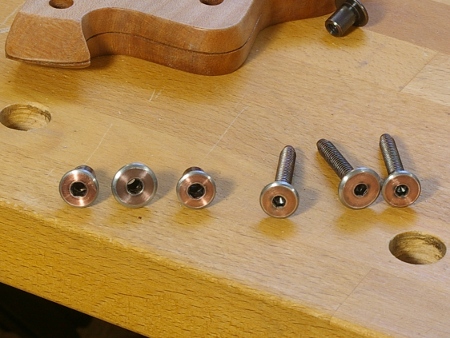
Now, the second problem I was having was that I couldn’t increase the blade tension too much, because the little screws that I was using to hold the blade in place were snapping due to the tension:

frame_saw_failed_pins

Yikes. So I cut and filed a few brads for this purpose:

frame_saw_new_pins

Now that there’s enough tension, I don’t have a problem with the blade twisting around (thanks for the pointer, Dan). The only issue I have now is that it’s difficult to keep the blade straight when tightening it up. Christopher Swingley uses a wrench on the flats, which seems like an idea that might work.

After making these two changes, this saw really seems to be on the right track, and I think I’ll be able to do decent work with it. I already sawed out some 3/16″ slices from a couple of smaller boards (without even marking!), and they came out great.

There always seems to be a lot of discussion about frame saws, and what kind of blade is appropriate. Tom Holloway’s saws use thin blades, and I can attest to how effective they are, having played with them. Bob Easton uses thicker blades from old Disston saws and that seems to work too. It seems to me that there’s more than one way to skin a cat.

A case in point here is what I edited in as a note in my last post, that there’s a version of a Japanese saw, the “oga kobiki” or something, that has a gigantic blade, but seems remarkably easy to use. Check out the pictures in this link if you haven’t yet. You see how that tiny woman is using that huge saw? Look at how beautifully the cut turns out. Oh, how I would love to examine that saw that they’re using.

So it seems that if the kerf is even enough–not too wide, not too narrow, of constant width, and straight–it doesn’t matter how big your blade is, as long as it’s slippery and sharp.

I don’t think this is going to be the last blade for this frame saw. I’ve got some ideas that might make it faster. Let’s just say that the gigantic teeth on the Japanese saw got me thinking.

I also got to thinking that I might need to do something about my saw vise. It works pretty well for small saws, but when you start to file the big teeth, it shakes too much. What to do here? Finally make my own? Cave in and get one of those new Gramercy saw vises? Find someone who has a good one and mug them?

Frame Saw: Almost Finished

To make the handles into one end of the frame saw, I first marked out the length-wise dimensions with a pencil and the cross section limits with a marking gauge (hard to see in this photo, but they’re there):

frame_saw_handle_markout

Then I set to work shaping the handles. I used my Shinto saw rasp first. I really like that tool: cheap, innovative, and highly effective.

frame_saw_handle_rasping

To finish shaping, especially at the edges, I used my Gramercy saw maker’s rasp. Then I smoothed it out with progressive grits of sandpaper on a dowel, starting at 120 grit. Finally, I hand-sanded to 320 grit, and called it ready:

frame_saw_handle_shaped

Then I assembled the saw with the newly-waxed blade:

frame_saw_assembled

So far, so good. I tried it out and quickly found that I will need to do some version of the trick that others have done to keep the blade square. It does tend to slip around. It also seems like it’s necessary to practice technique, because this thing does have a tendency to slip out of the kerf because the blade is so thin.

And then there’s the issue of workholding. Hmm. Clearly there is more work to be done here.