
On last year’s trip to Taiwan, I encountered a cabinet at the in-laws’ place that I found interesting. This year, I got to take a closer look and some photos.
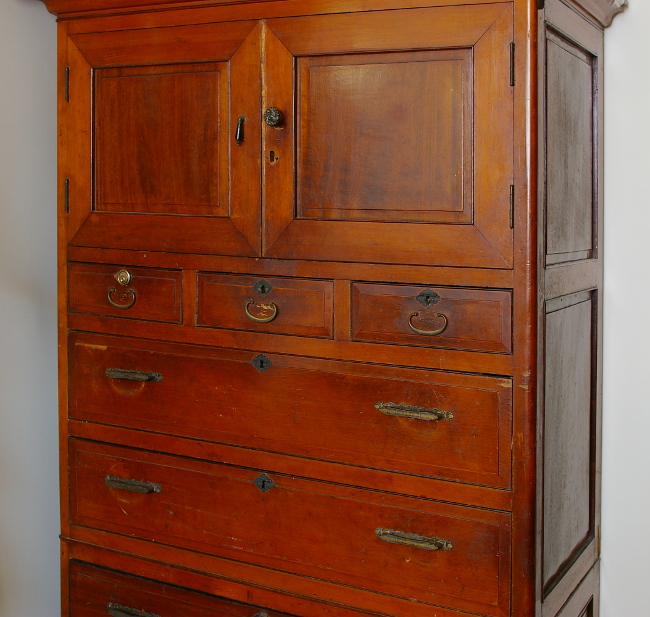
It’s probably about 90 years old. My grandmother-in-law says that her husband bought it before they were married, and he bought it from a Japanese friend or vendor (at this time, Taiwan was a territory of Japan).
It was likely not the most expensive cabinet that you could buy at the time, but its construction clearly indicates that it was a good quality item and that it was primarily (if not completely) made by hand–I don’t see any machining marks on it, and at this time, machine tools were not in common use in the area.
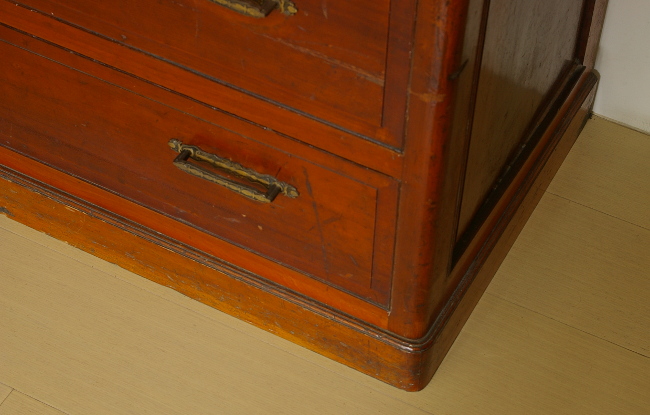
The design is pleasant and streamlined. It consists of two pieces–the upper part shown in the preceding image, and a base with two more drawers on the bottom. The base has a kickboard that matches the overall design, and is well-moulded:
Last year, what I noticed first about this piece was that the doors had the mitered-face mortise-and-tenon joint that I wrote about (and made) last year:
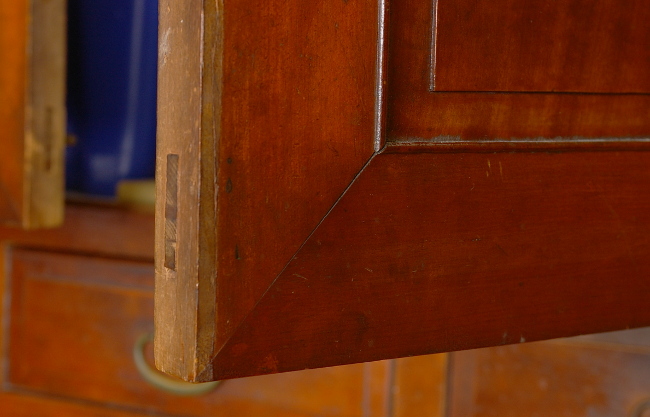
The tenon (like most of the ones I’ve seen here) is a through tenon. It’s very common in furniture here, and I now know the Chinese name for it–but I’ll save that for later.
The drawer construction would bring mixed reactions to some western joinery enthusiasts–the sides are tacked in. Though our first reaction might be to poo-poo this, remember first, that dovetails are not common in eastern furniture, and second, that this thing is 90 years old, and these drawers are still very solid. The humidity differences it has had to endure have been quite extreme–from very humid and sticky summers to a life in an air-conditioned environment.
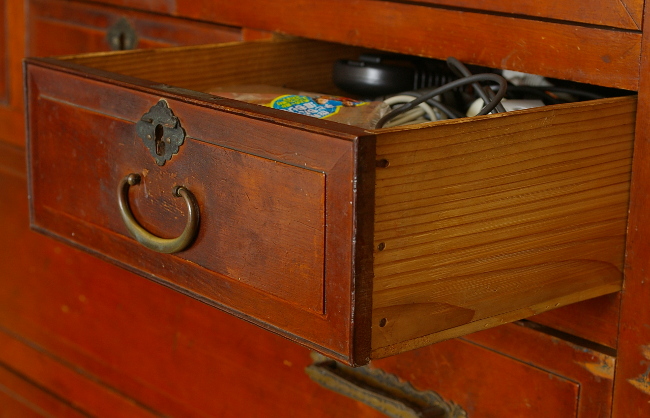
It’s all solid wood construction. The face is a good-quality light-colored hardwood that’s been lacquered, the rim around the face is an expensive dark wood (don’t know what, but it has large pores). The rest is a quick-growing softwood of some sort.
The rest of the drawer is also quite solid, in spite of violating “rules” of drawer construction (tacked together from the bottom, bottom panel grain runs along the front-to-back axis rather than side-to-side):
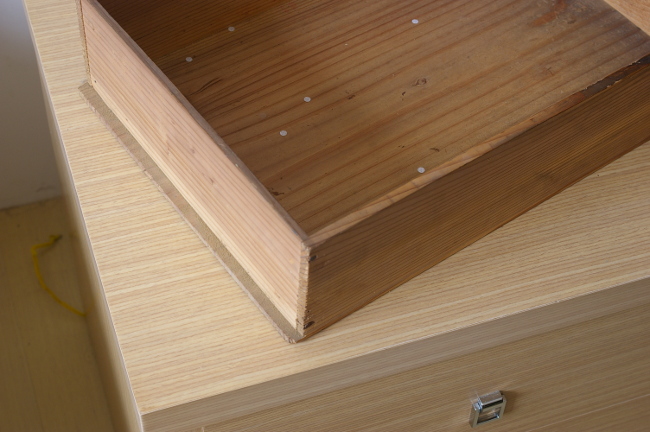
Notice the “rear deck” on the back. It’s not of a consistent width. It serves as a drawer stop–I am speculating that the builder intentionally let this protrude and then simply trimmed the end to get the drawer to stop flush with the front of the cabinet.
Here’s the hardware on the lower drawers. I don’t know if this is the original, but it’s kind of cute:
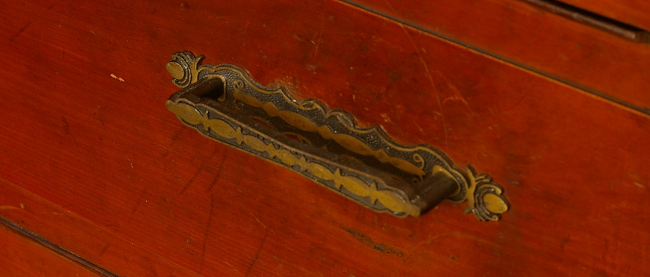
[Edit: It’s not original; in the picture at the top, you can see where the original hoop handles were. Thanks to Daniel for putting a finger on this.]
Now, with all of this said, there’s a further story with this cabinet. Over the years, the wood has moved in such a way that made the drawers very difficult to close. It was even said that they might have to get rid of it because it was so difficult to use. So I said, hey, this is the best piece of furniture in this house, and I could get the thing in good shape.
I didn’t have any appropriate tools (even after a ritual tool-shopping trip that I’ll talk about later), or any I could borrow, so of course, I decided to go buy something. I went down to the tool shop in search of a chisel and some sandpaper to sharpen it.
The sandpaper was easy enough. But I wanted a Taiwanese-made chisel, and got one. However, it looks like this:
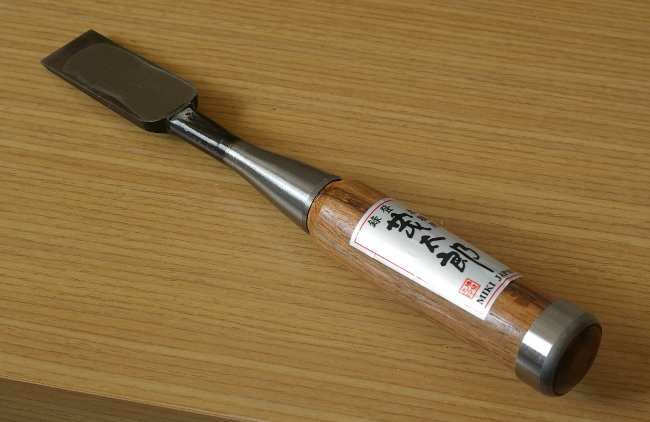
Yeah, it says “Miki Japan” on it, with a name. This is one thing that sometimes drives me up the wall with Taiwanese manufacturers. An example of this is that you’ll often see labels like “Boozoletti Italy” in stores on clothing that’s made in Taiwan, on really decently-made stuff. (Yeah, you can get not-so-well-made stuff too, but that’s another story.) It’s almost a very strange parody of the knockoff concept. Some companies have wised up and created their own unique identities, but that’s another story, too.
In this case, the chisel is made of the laminated (laid) steel that you’d expect from something like this, and it takes and holds an excellent edge. The grinding was excellent–it took only a few minutes to flatten and polish the face. Perhaps it doesn’t hold an edge as well as the famous Japanese chisels (not sure about how to test that), but it’s as good as any mass-produced western manufacturer of the past such as Union or Pexto.
And it cost a grand total of about $7.50. Best of all, it got the old cabinet in great shape in very short order.
 Galoototron