
There I was, thumping away at a mortise in the stool top. Whap whap WHAP, hey, something just got funny. Remember how I hinted that the Ash chisel handle might bite it? Well, it turns out that the chisel made a pre-emptive strike (notice the perpetrator lurking in the background here):
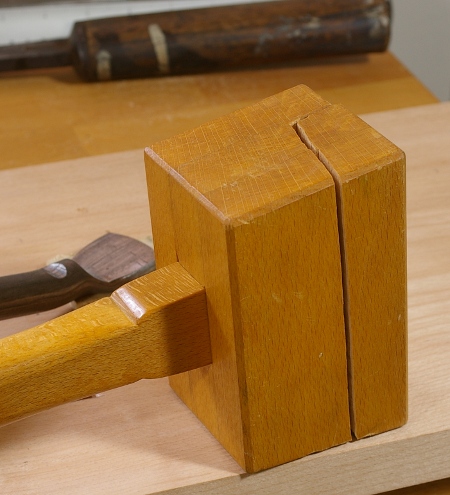
A totally predictable failure pattern, I suppose. I did the only natural thing here and glued it back together:
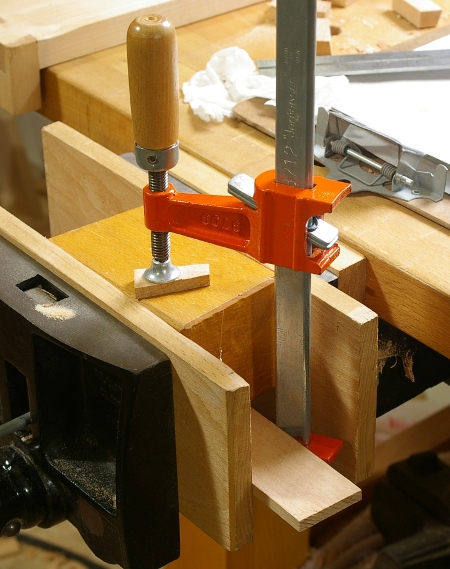
I don’t know how long this repair is going to last.[*] In theory, it should be okay if I manage to strike in the center of the mallet, but then again, the ultimate reason that this happened was because I didn’t hit the chisel handle in the center.
There’s a lesson to be learned here. Maybe one or more of these will help in the future:
- A bigger mallet for bigger jobs like this. [note: Joel from Tools for Working Wood commented that this may not be the greatest of ideas: the mallet head should be softer than the chisel handle.]
- Strike in the center.
- Make the mallet out of wood with an interlocked grain.
- Not hit the chisel so hard.
[* Edit: July 24, 2011, about a year and three months later. However, the new break was totally different.]
 Galoototron